Monthly Archives: December 2015

Here kitty, kitty…

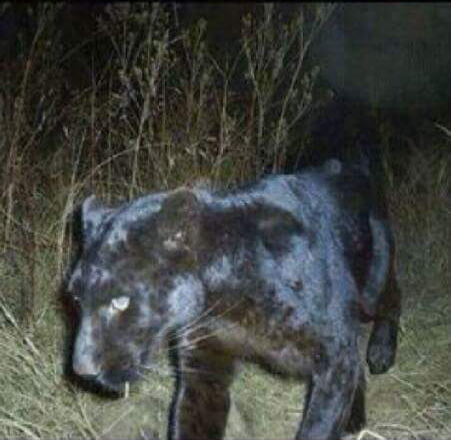
pantherI found this image of a panther on Facebook. Look closely and you can see it is a black variation of a spotted panther. You can see the spots on his foreleg. Folks say they don’t exist in Louisiana. Well, supposedly this game camera image was taken in Louisiana. (For the uninformed, game cameras are set up in the woods, usually strapped to a  tree along game trails or looking over automatic deer feeders. They take a picture automatically when the sensors pick up the evidence of something moving nearby.)

Panthers are indeed out there, but sightings are extremely rare and usually at a distance where it could be argued what was seen was something else, like a deer or a hog, or even a big house cat. But I know two people who have seen panthers.

One was my friend Sharon P. She saw hers in south Mississippi—close to Louisiana, right? Sharon is an avid hunter and has trophies on her wall that would make most any hunter envious. My point is, Sharon is a savvy woods-person and is not prone to hysterics, thus, in my book, if Sharon saw a panther, Sharon saw a panther.

The other sighting I am aware of was by my friend Buck. He was a heavy equipment operator in his early life after discharge from the Army and was working as a dozer operator on the Sunshine Bridge, which was built in the early seventies, if not mistaken. The equipment was stored at night in a marshaling yard some distance from the bridge site, and each morning Buck had to drive the dozer to the work site on a levee . There were cane fields on one side of the levee and woods on the other, if I am remembering this correctly.

This particular morning was extremely foggy with restricted visibility such that you could see only a few yards. He waited for the fog to lift but soon got bored with that and cranked up his dozer and started the trip to the site. Even though the fog had lifted off the ground a few feet, up in the elevated cab of the big dozer, he could see only a few yards ahead, and staying on the levee was difficult.

He got aggravated with that, so, he shut it down and lit up a cigarette and sat there in the dead silence, waiting for the fog to lift.

It didn’t, and he eventually had to relieve himself of his morning coffee, so he stepped out of the cab onto the track of the dozer, then dropped to the ground. Upon landing, he was face-to-face with a black panther.

The cat screamed!

Buck Screamed!

The cat did an about face and took off!

Buck did an about face and took off—but his trip was cut short when he ran smack into the tracks of the dozer. That hurt!

Buck said he spoke to some farmers about this later, and they confirmed they had also been seeing a panther in the area. So, don’t let anyone tell you there are no big cats in Louisiana.

Leave a comment

Filed under Family History, Growing Up

The Brave Rifles

Near the end of my book, The Last Day of Forever, I have my main character, Ethan, as a young second lieutenant in a unit called the 1st Regiment of Mounted Riflemen out in New Mexico Territory. They did exist—and still do. Here are some highlights of what I discovered in my research for this portion of the book and this particular regiment.
3rd ACR copy

The Regiment of Mounted Riflemen was created as a very early version of a modern mechanized infantry regiment, in a manner of speaking, that is. They were mounted on horses and rode to the fight, but once there, they dismounted and generally fought on foot. They were also issued rifled muskets instead of the usual smooth bore muskets the infantry of that period carried (prior to 1861) or the much-hated Dragoon muskets carried by other mounted troops. The Dragoon muskets were inaccurate, and the ball was prone to rolling out of the barrel if the barrel was pointed downward. In my book, I have the Brave Rifles armed with Sharps carbines. I could not determine if they were actually so armed prior to the Civil War or not. Some mounted units were indeed armed with Sharps during the prewar period, so I took a little artistic license on that point.

The Sharps carbine was a breech-loading weapon (verses muzzle loading, which means it was loaded from the back or breech end instead of the muzzle end). This made reloading much faster and easier, especially on horseback. The cartridges of the early model Sharps were made of paper and contained powder and a bullet. The trigger guard/lever was swung down, dropping the breech block to expose the chamber for inserting the cartridge. Once loaded, the lever was returned to the closed position, and the breech block closed with a sharp edge clipping off the back of the paper and exposing the powder to the priming charge. A primer cap was inserted over the nipple. Pulling the trigger dropped the hammer on the primer, igniting it and in turn the powder charge. Being rifled, they were much more accurate and had longer effective ranges than the other smooth bore arms of that period. Later model Sharps used metallic cartridges that were fully self-contained; projectile, powder, and primer cap all in a brass case. The longer rifle versions of the Sharps became favorites of buffalo hunters. If you ever saw the movie Quigley Down Under with Tom Selleck, it was a Sharps rifle that Matthew Quigley used.

Sharps Model 1853 Military Rifle

1853 Military Sharps

The Regiment of Mounted Riflemen was formed in May of 1846. Under various names, it has seen action in all of America’s major conflicts since then, including The Mexican-American War, The Indian Wars, The Civil War, Spanish-American War, World War I and WWII, as well as service in Iraq and Afghanistan.

It was in the Mexican-American War in 1847 that the regiment got its nickname, “Brave Rifles,” and its motto, “Blood and Steel.” After several major engagements, the exhausted regiment was visited by General Winfield Scott. He had come to order the regiment to Churubsco for an even more difficult battle. He removed his hat, bowed low, and said: “Brave Rifles! Veterans! You have been baptized in fire and blood and have come out steel!” Even today members of the unit greet each other thusly: An enlisted trooper renders military courtesy to an officer by saluting and yelling out “Brave Rifles!” The officer will return the salute and reply just as loudly, “Veterans!”

The regiment is also thought to be the origin of “Gringo,” the modern Hispanic slang for an American. The regimental marching song, which dates back to the Middle Ages, is named “Green Grow the Rushes, Ho!” Legend has it the Mexicans slurred the “green grow” into “gringo.”

In 1848 the regiment returned to Jefferson Barracks, MO where it was originally formed, and in 1849 was sent on a grueling march all the way to Oregon Territory. Two years later, they returned to Jefferson Barracks and were officially designated as the 1st Regiment of Mounted Riflemen (previously without the “1st” designation) because the Army expected to raise two more such regiments. That never happened.

In 1851 the regiment was ordered to Texas, and in 1856, they moved further west into New Mexico Territory. (Ethan joins the regiment in 1860 and resigns in early 1861.) They had a very large territory to police and never enough troopers to do so.

With the advent of the Civil War, all mounted regiments were organized as cavalry, and the 1st Regiment of Mounted Riflemen became the 3rd US Cavalry Regiment. They fought in the Civil War, mostly in the western theater, first in Texas and later in Missouri, Tennessee, and Arkansas.

In 1866 the Brave Rifles were ordered back to New Mexico Territory to campaign against the Indians.
Old_Bill_Cavalry_Mascot_Poster

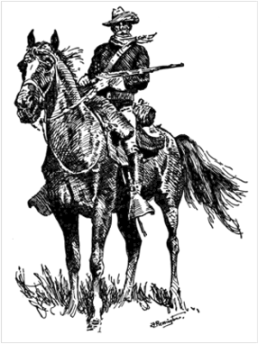
In 1898 the Brave Rifles arrived in Tampa, FL for deployment to Cuba during the Spanish American War. The famous western artist, Fredrick Remington, was visiting the regiment’s camp. One of the regiment’s NCOs, Sergeant John Lannen, caught his attention as representing what Remington considered to the epitome of the American cavalryman, and he sketched him. The drawing eventually became known as “Old Bill.”

During World War I, the regiment deployed to Europe and saw only limited action, but during WWII, they traded in their horses for armored vehicles and were reorganized as the 3rd Armored Cavalry Regiment, serving in Europe. It was troopers from Troop B, Reconnaissance Squadron of the 3rd ACR that were the first Americans to cross into Germany, albeit only a short excursion to prevent the Germans from blowing a vital bridge.

The Brave Rifles served in Iraq during Desert Storm. In 100 hours, they covered over 300 miles, rolling over three Iraqi divisions in the process. They also served in Bosnia and more tours in Iraq and Afghanistan.

In 2011 they were renamed yet again as the 3rd Cavalry Regiment and traded in their heavy armor for lighter and faster Stryker armored vehicles. They are currently based at Fort Hood, Texas.

Leave a comment

Filed under Catahoula Books, Civil War, Firearms, History Lessons, Last Day of Forever

Joey Giammalva

Last night Janis and I ran into Beverly Giammalva at a function. She is the widow of a very dear old friend, Joey Giammalva. Joey and I grew up together in Kenner, and we go back as far as I can remember, like when I was around six. I lived on Sixth Street near the corner with Williams Street. Joey lived on the same block as me but facing Minor Street, and just so happens right across the street from my future bride, Janis Cristina.

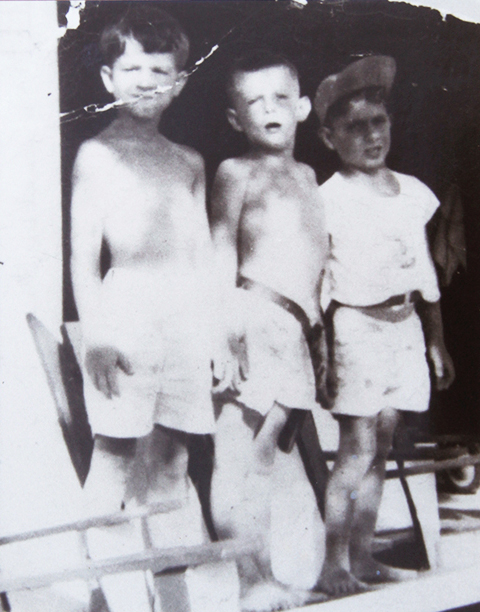
Me, Manard, Joey 1953Joey, Manard Lagasse, and I were the closest of friends in those days and remained so through high school, even though I went to East Jefferson, and Joey went to De La Salle. We kind of drifted apart after that, simply because we were separated by schools. Both Manard and Joey were two years younger than I was. Joey and I reconnected a bit, when I transferred to the University of Southwest Louisiana, and he was attending there.

As I was talking to Beverly, my emotions were flooded with memories of Joey and me as kids. What came to mind?

For one, his home on Minor (in which Beverly still resides). I can still picture every room. I would show up there on Saturday morning and find Joey watching TV in their den, a smallish room at the back of the house. He had a back porch that was initially only screened, and then Mr. Giammalva added jalousie window glass. We were not allowed in the living room. The sofa was even covered with plastic. No, I’m not making that up. I think they used that room only once a year, Christmas.

And, of course the kitchen.

Mrs. Giammalva (Miss Mary) was a fantastic Italian cook and somewhat tradition bound, because they had the same meal every Sunday at noon: spaghetti and meatballs and fried chicken. I’m not sure, but I don’t think fried chicken is very Italian? Whatever, it was great fried chicken! I must confess that I sometimes managed to be around the Giammalva house about lunch time on Sunday a bit more often that perhaps I should have been, and naturally, they invited me to eat with them.

Mr. Giammalva was an ice peddler for my future wife’s family business, Cristina Ice in Kenner. He delivered ice (some of us still had “ice boxes” then) to homes and businesses in his red, stake-bed, Studebaker truck. I will never forget that truck.

And get this! His helper was none other than Lloyd Price, before he became a famous recording artist. Some of his hits: Lawdy Miss Clawdy, Staggerlee, Personality, and I’m Gonna Get Married. A resident of Kenner who made good.

Mr. Giammalva also was a part-time trapper. He ran a trap line somewhere west of Kenner and brought in muskrat and little animals I think were mink. He treated the skins and hung them to dry in his two-car garage.

I spoke elsewhere of Joey and me having Red Ryder BB guns. Did you know robins were good table fare? I didn’t either, but the enterprising Mr. Giammalva did. Robins migrate and in the fall stopped on the way south in his hackberry tree to feast on the little hackberries, often filling that tree with robins by the hundreds. Mr. G and Joey’s Red Ryder BB gun were waiting for them. Many robins went into his freezer after getting their fill of hackberries. And no, that wasn’t legal. But, hey, it was Kenner in the 1950s.

Joey was a bit chunky when we were young but slimmed down as an adult. He suffered from flat feet, and I mean flat as pancake. We often played with the hose on the summer and Joey’s feet would make flatulence sounds on the wet concrete. Funny what you remember. And that one brought on the tears.

We also had go-carts, and we were often chased by the Kenner Police for running them on the streets of Kenner. I wrote about some of those adventures here and here.

The photo above of (from left to right) me, Manard Lagasse, and Joey was taken by Mrs. Giammalva in Joey’s back yard. He carried that old photo around in his wallet for decades. Finally about twenty years ago, he made 8×10 copies for Manard and me and presented them to us. It hangs in my home office. I am sorry to say that both Manard and Joey are gone now.

I miss them both, and unfortunately, we often don’t realize how much we miss someone until they are gone. If you have friends you love, spend time with them, because they won’t be here forever, and neither will you.

4 Comments

Filed under Family History, Friends, Growing Up, Kenner

The Avenging Angel

I have been asked if I plan to write a third book in the Catahoula Series. I do and am working on it now.

It begins in July of 1866, a year after An Eternity of Four Years ends, and carries the reader into that period after the War Between the States called “Reconstruction.” In many respects, Reconstruction was as bad as the war was for the South. Racial tensions ran extremely high and often exploded into violence as the former “rulers” (the planters) attempted to regain some semblance of control over the shattered southern economy and their former servants (the freedmen). The antebellum system of authority was broken by the war and emancipation. In its place, a new system emerged that more resembled chaos. As one would expect, the planters didn’t take well to the change.

Some northern interests wanted the South severely punished for what they had done and saw Reconstruction as a chance to extract that punishment. Southern culture and traditions were turned upside down, and southerners struggled to deal with the changes while attempting to make a living (avoid starving), pay taxes on unproductive property, and rebuild the South.

Out of the chaos came organizations like the Klan and later The White League and the Knights of the White Camellia along with all the violence, mostly against African Americans, that was part of that.

The working title for Book 3 is The Avenging Angel (which is subject to change). It tells the story of Rachel and Ethan attempting to build their lives together in the middle of all this. Along with the familiar characters Ethan, Rachel, Analee, and Pernell, you will meet a few new ones, and see a couple of old ones come back into the story you have not seen since Book 1. Ever wonder what happened to Brandy and Zeke after they ran away?

It is a work in progress that I have only outlined and written a few chapters. A lot of research needs to be done, and story details remain to be worked out, written, and edited before it will be published. I hate date setting, because I am always wrong, but I hope to have it published by the summer of 2016. I will do the best I can, but don’t hold me to that.

Meanwhile, here is the opening scene from chapter 1 of The Avenging Angel to wet your whistle.

*****

From Rachel‘s Diary

28 July 1866

I knew, by the stern expression on my husband’s face, that he was nearing the limits of his patience. Listening to Mr. Waldo T. Pettigrew expound upon how he had been sent by Washington to repair the broken South and lead it from its wayward rebellious ways back into the Union fold. In his tone, you could hear the man’s utter contempt for people like us, southerners, whom he considered to be beneath his station, and that was not sitting well with Ethan.

Four years of war tends to change a man, and I knew it had affected my husband in ways I was yet to fully understand, but I was sure his tolerance level for carpetbaggers, like this one come to bring us the way, the truth, and the light of his enlightened existence, was much diminished.

“Can you swim?” Ethan asked him in a dry, matter-of-fact manner.

Upon hearing that, I frowned as I looked over the rail of the riverboat at the swirling, muddy waters of the Mississippi passing below. I knew exactly what he had in mind to do. “Ethan, please don’t.”

As this pompous ass pontificated on his considerable swimming ability, being as he was from the Atlantic Coast, Ethan noted my pleading expression punctuated by my arched eyebrow expressing my displeasure, a trick I learned from his mother. Thus admonished, he tipped his hat to Mr. Pettigrew and excused himself from his company.

I lingered for a moment when Pettigrew inquired of me, “Why did he suddenly leave? Did I say something that offended him?”

I smiled. “I believe he found your attitude toward the South offensive, as did I. And I would advise you to temper your speech during your stay in Louisiana—unless you fancy wearing tar and feathers.”

Mr. Pettigrew’s shocked expression indicated he clearly understood my meaning. “But—why did he ask if I could swim?”

“Because, you, sir, were about two seconds away from him grabbing you by the scruff of your skinny neck and the seat of your finely tailored trousers and tossing you overboard. You are not treading water right now, only because I asked him not to do it.”

His expression went blank as he took a deep breath and sighed before replying barely above a hoarse, stuttering whisper, “I–I lied. I can’t swim.”

I shrugged. “Then I just saved your life.”

Leave a comment

Filed under An Eternity of Four Years, Catahoula Books, Civil War, The Avenging Angel