Jeepin’ – Boys and Toys

All of my childhood I wanted a Jeep. In high school, I dreamed of my first car being a Jeep, but alas, it was a ’57 Chevy, but that’s another story.

After college and four years in the Air Force, Janis and I settled back in NOLA on Jefferson Street. We had no money beyond what we needed, and the Lord supplied all our needs, but He had not supplied me with a Jeep.

Along about 1975, my buddy, Buck Roy bought a Toyota Land Cruiser, the old flat fender model, which was almost a Jeep. And then my sister bought a little red Jeep. That did it! I HAD to have a Jeep then and decided the Lord needed some help.

M38A1 Jeep R

Heath and our M38A1 after a trip to the Bonnet Carré one Saturday.

I found a very used, 1952, military surplus M38A1 Jeep for sale that had recently been freed from the Mississippi Army National Guard. It was so recently freed, it wasn’t even street legal, lacking some necessary lights. Top speed was 55mph. That was mainly because of the very low gearing in the axels. Its military 24 volt electrical system had been converted to 12 volt, and it did have a new soft top. Tires were almost new and in great condition, and it ran good. I bought it and commenced to make it street legal and eventually got a brake tag for it.

It did, however, have about 200 coats of OD paint on it. In case you have never been in the military, it works like this: “IG inspection coming up? Paint everything!” (Because nothing looks as good as something just painted.) That did help prevent rust. I eventually added a layer of my own when I camouflaged it using rust red primer, yellow primer, and flat black. I then added white pinstripes to accent the body panels. It actually looked cool. Well, I thought so.

Jeeps ain’t made for the road; they are made for the off-road, and the nearest such off-road was the Bonnet Carré Spillway west of NOLA. The fine silt sand in the Spillway could get past seals and eat bearings, so it was one of the worst places we could go play, but it was all we had. And we went running through every mud hole we could find to see who would get stuck. I am proud to say my little M38A1 never got stuck. Put that puppy in low range, first gear, and it would climb a greased flag pole.

Elder son, Heath, was about six then. Ryan was only a year old or so. Heath made more than a few trips to the Spillway with “Uncle Buck” and me, but poor Ryan was too young. On one trip, we got hooked up with some guys with their jacked-up, big-tired pickups, and they challenged us by running through stuff they figured would stop the little M38A1 or the Toyota. We fooled them.

One particularly hole of deep water, about a block long, nearly did us in, however. Heath and I dived in, and water came over the hood, but we puttered along with the fan blades of that little Hurricane Four Cylinder Engine slapping water and making fluttering sounds.

“Dad! We have water inside!

I looked over at Heath, and he had his feet up on the seat, and water was spilling in under the door. That was OK, because I had drain holes in the floor. Besides, we couldn’t stop or turn back. All we could do was plow ahead with the water rolling over the hood and hope the electrical system stayed dry long enough to get us through to dry land

It did. We climbed out with the engine sputtering and spitting. I revved it a few times to keep it running, and eventually it dried out enough to run smoothly.

The big-tired truckers shook their collective heads and said, “Never figured you would make it through that.”

That Jeep was my daily driver. I went to work in the city in it every day, and with no AC—and I was wearing a suit! We played in the Spillway on Saturday, and I spent Sunday under it, fixing what we broke. I loved that Jeep, but…

After a few years I was making enough to buy a new vehicle, and Janis near fainted when I announced I was buying a new 1978 Ford Bronco—four-wheel drive, of course. That was the first year they came out with the full size Bronco like the Chevy Blazer. I had one of those, too, a 1978 Chevy Blazer to be exact, but that was nearly twenty years later. Heath found that one in Texas.

The Jeep had to go.

The Bronco was a lot more comfortable—it had AC—and it became the vehicle we used for all family trips. Heath and I made many a deer hunt in that Bronco, sleeping in beds I made in the back. While I never got the little Jeep stuck, I managed to get that big heavy Bronco stuck bad enough it took two vehicles to pull it out one time. It was buried down to the tub, and the tires could find nothing to grab.

After the Bronco came the Jeep Cherokee Chief, also four-wheel drive. Made a bunch of deer hunts in that one too. After that no more four-wheel drive until the short-lived ‘78 Blazer mentioned above. It didn’t like humid Louisiana and quickly developed cancer. That was after it blew a head gasket on the way back from Alabama, and I had to have the heads rebuilt. I would have kept it if it had not developed the rust problem.

I figured I was maybe past having another four-wheel drive vehicle. The Spillway had long since been closed to such use, and I had given up deer hunting. But I had one last fling with a 2005 Chevy Crew Cab Z71, but I only used the four-wheel drive once when it mattered, and that was on I-20 on the way back from Abilene in a snow storm.

Both Heath and Ryan caught the Jeep bug, and both now have Jeeps. Heath’s is an older model that he is doing a body-off resto on, and Ryan’s is a newer model he has jacked up and put big rubber under it.

I have nothing now but a two-wheel drive Ford Crew Cab, but…I’ve been thinking of getting another M38A1, but one that someone has already restored.

Don’t tell Janis.

Leave a comment

Filed under Family History, Growing Up

More Stupid College Boy Capers

When I got a bit more serious about my college education; that is I realized I couldn’t make a living in fine art or my then minor, beer, I transferred to the University of Southwestern Louisiana (USL, which is now ULL, the University of Louisiana at Lafayette) and changed majors. I had heard they had a good program in advertising design, and that sounded like something that might actually generate some income.

St Joseph St

Sam made the trip with me, having come to the same conclusion about fine art, but Richard was doing a stint in the Army National Guard. Sam and I got a new roommate, Alvin Bartlett, who we knew from high school, and moved into an apartment on St Joseph Street. Al had just finished up his active duty time in the Navy Reserves. Al was just as crazy as Richard—and Sam and me, for that matter.

The Petty Wars continued with new vigor and fresh creativeness. Sam came home one day with a device about the size of a quarter and twice as thick, that you put in a socket behind a light bulb, and it would cause the light to blink. We installed it in the light over the bathroom sink and departed for the weekend back to NOLA, leaving Al to hold down the apartment.

When we came back, Al complained about the blinking light. He said he had finally managed to time his eyes to blink with the light and shave at the same time. We quietly removed the blinker and suggested Al should get his eyes checked, because the light worked fine for us.

One favorite trick was to wait until one or the other of us was taking a shower, sneak into the bathroom, and douse them with a pitcher of cold water. Much profanity and threats of death emanated from behind the shower curtain after such dousings.

I upped the ante one evening by adding lots of sugar to the cold water and waited for the target, which happened to be Al, to turn off the shower before dousing him. The usual death threats and profanity were forthcoming from the cold dousing, but Al simply proceeded to dry himself—until the towel started sticking to them.

One evening Al and I were cooking onion rings for supper, and Sam was scarfing them up as fast as we fried them. So…we twisted some pieces of paper towel into onion ring shape, battered them, and fried them up. Sam, naturally, stole them and ate them—and swallowed them, only to complain of how tough they were.

Then there was the famous sandwich caper. We were at the apartment for lunch and fried up some bacon for BLT sandwiches. Al and I finished ours, but Sam had only just finished making his and hadn’t even started eating yet. I informed him I was still hungry and could I please have a bite of his sandwich? Suspecting some trickery on my part, like stuff the whole sandwich in my mouth, Sam thought he was going to be clever. He smiled and said, “Sure,” whereupon he picked up his sandwich and licked the bread on one side before he handed it to me with a broad smile of triumph on his face. Even Al figured he had me that time.

With the “Chiclet’s Caper” from two years before still on my mind, I took the offered sandwich, licked the other side, and handed it back. “I’m not hungry anymore.”

Eventually, the local garbage men became targets-of-opportunity for our pranks. We lived in a the second floor apartment (the one on the left in the pic above), and our kitchen table was located under the front window. Window open on a warm spring day, we had a good view of the street as we ate lunch when the garbage truck came along, making their garbage collections. They had a system worked out. The nearly-asleep truck driver stopped the truck positioned so the back was near the garbage cans to be dumped. The “can-handler” dropped off the little step on the rear of the truck where he rode, grabbed the can, tossed its contents into the hopper in the back of the truck, tossed the empty can over on the sidewalk, and whistled for the nearly-asleep driver to move on to the next set of garbage cans.

You know where this is going, right?

Timing must be perfect, and it was. We waited until the “can-handler” was just about to dump the can and whistled. The half-asleep driver pulled out, and the contents of the garbage can ended up in the street. Not wanting to be reported by our neighbors across the street whose garbage was strewn all over St. Joseph Street, he had to pick it up. Much profanity issued forth from the can-handler, while the half-asleep driver waited patiently down the street at the next set of garbage cans.

My favorite story did not involve me. I was living in the frat house at the time, and Richard, fresh out of his six months active duty with the Army National Guard, had joined Alvin and Sam on St. Joseph Street. Alvin worked for CLECO (electric utility in Lafayette) and had to get to work around 7am. Sam and Richard set his clock ahead an hour, so Al woke up an hour early and arrived at work an hour early—only to find the gate locked. He should have been suspicious when he left the apartment with the sun just coming up, and usually, it was well up when he left. He probably wasn’t fully awake yet….

A very irate Alvin arrived back at St Joseph Street to find Richard and Sam having lunch. Richard looked at him and calmly said, “We expected you home an hour ago.”

Leave a comment

Filed under Growing Up, School

Petty Wars – Stupid Things College Boys Do

If only we had applied ourselves to our studies with the same enthusiasm we applied to having fun, all three of us, me and my two roommates, were capable of being honor students, however, we were not so inclined to make that application. We were freshmen at Southeastern Louisiana College, a “suitcase college” only an hour from home, so most of us went home on the weekend. One of our diversions from study was what we came to call “Petty Wars,” which was a series of continually escalating conflicts involving silly trickery and gags between me and my two roommates, Sam Hopkins and Richard Caire, or between the three of us and some other person or group.

I forget how the Petty Wars started, probably some stupid college kid prank, like me stealing Sam’s Boston Cream Pie desert in the cafeteria. I distracted him by pointing out the “assets” of a particularly lovely coed, and when he turned to look, his slice of Boston Cream Pie, which was his favorite kind of pie, had disappeared into my mouth—all of it. He turned back to see me looking like a chipmunk with a years worth of nuts stuffed in my cheeks and Boston Cream Pie oozing from between my lips.

Or it may have been our stealing of Sam’s mother’s chocolate chip cookies, which he tried to hide in the dorm room. Come on! How many places can you hide a tin of cookies in a dorm room? Sam’s mother made great cookies. He did share them, albeit doling them out maybe one to each of us on Sunday night when we arrived back on campus. He figured that would satisfy us, and he could eat the rest while we were in class, assuming we even went to class, but that’s another tale.

Sam was and is clever, and he got me good. I came in from class one afternoon and neither Sam nor Richard were in the room, BUT “stupid” Sam had left his box of Chiclets Chewing Gum laying out on his desk—in plain sight—just begging to be stolen! Just in case you don’t recall, Chiclets come in a small box of about ten pieces of little  pillow shaped chewing gum, each of which is coated with a hard sugar coating, like M&Ms.

Well—guess what? I scooped the pack up and tossed two pieces into my mouth and went to chewing. I then went next door and passed the gum around to our neighbors, commenting how “dumb” Sam was. They all took some themselves, and we finished the whole pack in one sitting.

HOWEVER, none of us took note of the fact that the “Chiclets” were not their usual square shape but were rectangular, and the flavor was a bit off. All we cared about was they were free and “careless” Sam’s gum.

Ever hear of a product called Feen-A-Mint gum? Wikipedia defines it this way: a laxative that stimulates bowel movements—kind of a dry way of saying you will become very attached to a toilet for the next 24 hours. Feen-A-Mints look an awful lot like Chiclets, and even taste a little like Chiclets, but they are not square shaped like Chiclets; they are rectangular shaped. That’s right, we all sitting there chewing away on a double dose of a rather strong laxative!

Sam got a good laugh, and for those of us who had partaken of “stupid Sam’s Chiclets,” attending class the next day was completely out of the question.

After that, the Petty War escalated but shifted from interpersonal to between rooms, namely the guys in the room next door with whom we shared a bathroom. We lived in Holloway-Smith Dorm. It was a two-story “V” shaped into two wings broken up into four room suites, two on each side of a common bathroom of four sinks, two toilets and a large shower stall. The rooms opened to the outside and also to the common bathroom, of course.

With a recent escalation of the war by our neighbors next door (I forget what they did but it demanded retaliation), I put my engineering skills to work, which turned out to be a pretty impressive skill set, considering I was an art major.

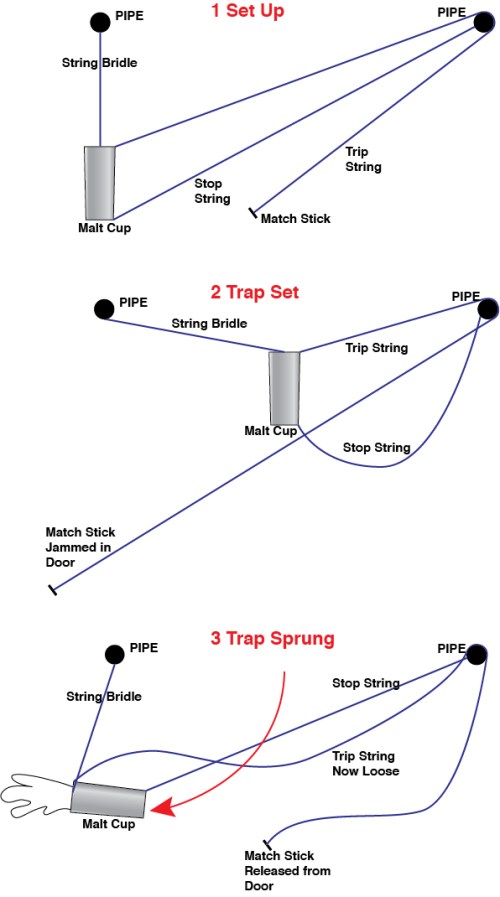
The exposed plumbing ran overhead in the bathrooms, a feature that proved beneficial for my “Mechanical Marvel” retaliation device. From the pipe above, I hung a large malt cup by two strings through the lip directly in front of the offending neighbor’s door. I hung it at about chest level. I attached another string to the bottom rim of the cup on the side away from the door and looped the other end over a pipe on the opposite side of the bathroom, pulled it taut, and tied it off.

Next step was to fill the cup with something gross. That turned out to be just water and shaving cream. Might have been a little urine in it; I don’t recall?

Now, the final touch: I tied a string to the lip of the cup on the side away from the door, looped the other end over a pipe on the other side of the bathroom, then carefully pulled on that string. As I pulled, the cup, supported by its bridle and now the third string, slowly swung up towards the ceiling. Get the picture? The cup is hanging from its bridle and the third string up near the pipes now.

I stretched out the string all the way back to the door of our target, tied a matchstick to the end of the string, then stuck the match stick between the door and its jamb. The “booby trap” is set, and we retired to the day room to watch TV.

About an hour later, we were confronted by a very irate neighbor, who was also very wet. It had obviously worked! And while he was mad, he was also impressed.

This is what happened:

  1. Target neighbor comes home and goes directly to the bathroom to relieve himself.
  2. He opens the door, releasing its hold on the match stick
  3. String holding the cup of joy up near the ceiling is no longer doing so
  4. Cup is now free to swing back to its rested position—and it does
  5. At the end of its swing arc, the string tied to the bottom rim goes taut, upending the swinging cup
  6. Upended cup dumps contents onto surprised target neighbor


Prank Trap

He said when he looked up and saw the cup coming at him, he froze, mesmerized by this mysterious cup coming at him from out of the darkness.

No one ever topped that one for sheer cleverness. I should have studied engineering…

1 Comment

Filed under College

Another Satisfied Reader

Satisfied Reader

Sent to me by a friend. Obviously, The Last Day of Forever makes a good summer beach read. That one is a first edition.

Leave a comment

Filed under Last Day of Forever

The Chat

Recently, my Dish Network Satellite DVR “crashed and burned,” and took all my recorded stuff with it. I have been threatening to “cut the cable” (well, actually satellite signal, in this case) and going all streaming, using my Apple TV. I hate paying for channels I don’t ever watch. Alas, that was not in the works.

One problem, with going streaming only, is you give up any kind of a centralized content management system, otherwise known as the “guide,” where you can go surf channels to see what the different channels have on that you might want to watch or record for future viewing. Surfing, without access to a guide, becomes very complicated and a lot of work, because you have to shift between numerous content sources to make a viewing decision.

Back to the story.

A week after my DVR crashed and was reported to Dish, I get a new one, only it wasn’t a “new” one; it was “remanufactured.” That ticked me off, because the one that died was also remanufactured, a replacement for the first one that died. I wanted a new DVR, but they sent this remanufactured one. I was going to send it back and demand a new one, but that would have been another week without the “guide” or the ability to record and view later (without commercials).

They won. I installed the “new” remanufactured DVR.

Once installed and it is displaying something on the TV, you either call or go online and live chat with a representative to get the “new” remanufactured DVR activated for your account. Not wishing to wend my way through all the “press 1 for…” steps to get to someone at Dish on the phone, I chose the chat route and got out my iPad and signed into Dish. What follows is the sometimes humorous conversation that ensued.

I should note, that Janis and I had dinner after I did all the wiring of the “new” remanufactured DVR was doing its thing, conversing with Dish, before we got to the activation chat below. During that meal, I had a hardy glass of wine, which may have been a contributing factor to the direction the chat took.

Here follows the chat:

Zane Frederic (Dish Network): Hi, my name is Zane Frederick. How may I help you?

Allen Casteix (Me): I am trying to finish the setup of my new DVR. I need to authorize.

Zane Frederic: Good afternoon! I hope you are having a great day, Allen.

Zane Frederic: I’ll be glad to assist you.

Zane Frederic: What do you see exactly on your TV screen?

Was all that bloviating really necessary? I ignore it and get right to his question.

Allen Casteix: Some guy talking about my bill.

Zane Frederic: I see

Zane Frederic: For security purposes, would you please verify your account with your 4 digit security code?

We are not exactly coordinated here. I am still answering the question above about what I see on my screen, which has changed, a point I considered important, and I saw a cartoon TV shivering. I have no idea why it was shivering, because I had the sound muted.

Allen Casteix: Now a shivering TV

Zane Frederic: I understand.

Now, I am catching up and trying to answer the security code question, and I can’t remember the number, thus I started to type an answer indicating that, when the number suddenly came to me.

Allen Casteix: I have no idea what … wait XXXX. (I gave the code number)

Zane Frederic: Thank you.

Zane Frederic: Can you please describe exactly what is on your television screen now? If there is an on screen message, please include the 3 digit number found at the top right corner.

What is on the screen seems awfully important to Zane, and I have no idea why. Meanwhile, I had decided I needed to hurry this process along and typed the following message, jokingly, of course.

Allen Casteix: Bette hurry the wine is kicking in. A TV and a TV slot machine.

I answered his question about what I saw on the screen but missed the one about the 3 digit number. But then I realized my typo and corrected.

Allen Casteix: Better!

Old Zane doesn’t miss a beat.

Zane Frederic: I understand.

He is a very understanding fellow…

Zane Frederic: I already activated the replacement receiver and deactivated the old receiver

I think he gave up, because he went ahead and activated the “new” remanufactured DVR without me giving the number. By then I am realizing how this chat must look to Zane, and I’m laughing so hard I can’t type. Janis is looking at me like I am crazy as I try to type…

Allen Casteix: I’m going to have to save this conversation. Lol!

Again, Zane doesn’t miss a beat, but he finally drops the ball with a typo of his own. (I wonder if he had wine with dinner?)

Zane Frederic: Alrightj

Where did that “j” come from?

Zane Frederic: Do you have any other questions or concerns for me?

At this point, I am still laughing and want off the chat.

Allen Casteix: Are we done?

Zane Frederic: Yes.

Allen Casteix: Bye. Have a nice day.

Zane Frederic: You too

Zane Frederic: It is my pleasure to help you out. Again, my name is Zane. Thank you for using Dish chat and for giving me the pleasure to assist you.

Zane was very professional, and I can only imagine what kind of crazy chats some of the people must have. I bet he was thinking, I can’t wait to tell my wife about this goofy chat I had tonight!

Oh, and I think the “new” remanufactured DVR is broken.

Leave a comment

Filed under Growing Up

SCUBA — Part 2

Continues from Part 1 here.

The NOGI Spearfishing Rodeo was our big event of the year. Unlike the larger Grand Isle Tarpon Rodeo a month later, which was mainly a fishing rodeo with some added spearfishing categories, NOGI was a spearfishing rodeo with some line fishing categories. NOGI stands for New Orleans Grand Isle and was held in Grand Isle, Louisiana. Handmade from Honduran mahogany and signed by the artist, the NOGI trophies were highly coveted. The Bajaos sponsored one, and it cost us $100 back in 1964. They were beautiful works of art with sterling silver award plates. I have one, which takes me to the story of how I won it.

In 1964 we participated in the three-day NOGI Spearfishing Rodeo. We arrived in Grand Isle late Thursday night expecting our chartered boat to be waiting, a stripped down shrimp lugger capable of handling the dozen-plus members of the Bajaos on the trip and all our dive gear plus a compressor to fill the tanks while out in the Gulf of Mexico.

No boat! It was broken down, so a scramble began to secure another boat to get out into the Gulf before dawn on Friday, the first day of the rodeo. It was late, but we dug up an oil field crew boat, 60 feet as I recall. We managed to get everyone onboard and headed out sometime after midnight.

After several hours of travel and maybe an hour before dawn, we arrive at a some oil rigs. Anyone recognize these? Nope! Where are we? We had to wait for dawn to be able to read the rig’s nameplate that we tied off to. And with the dawn came the realization we were nowhere near where we thought we were. How did we get here? That is when we discovered the flashlight laying right next to the compass.

A quick scan of the maps showed we were about twenty miles from Grand Isle and in over 200 feet of water. But oh, what beautiful, clear, blue water it was! We decided to stay right where we were. That turned out to be a good idea. The rig was crawling with fish: Amberjacks, Barracudas, Red Snappers, Shark, and low and behold—down on the bottom, 220 feet down on the bottom, were Warsaw Grouper, which were rare to find during the summer months. They were in the deep cold water down there and living in the crumpled and cast off steel from the rig above after it had been rebuilt twice, once burned by a fire and another when a ship hit it.

Porpoise NOGI R

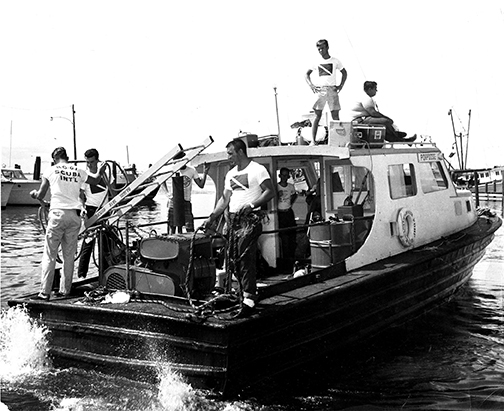
Bajaos returning on last day of NOGI on the “Porpoise.” I am second from left, third behind the ladder is Dee White, and Buck standing on the cabin.

We started hauling in lots of fish—trophy winning size fish! We returned to Grand Isle that evening and weighed in with our catch. Many Bajaos went on the leader board, including me with a nice Amberjack. We told no one where we had been and went back out later that night and again the next night. We took more trophy-winning fish, but some of our fish were getting bumped by larger fish as more divers returned with their catch. I was bumped right off the board by three larger Amberjacks.

Sunday rolled around, and I was off the board and getting desperate. I dived two tanks on two deep dives down as far as 180 feet with no luck. After consulting the dive tables, I decided I could make one more dive if I didn’t go very deep, but I would have to make two decompression stops to rid my body of absorbed nitrogen before surfacing if I wanted to avoid a painful helicopter evacuation to a hyperbaric chamber. I asked my buddy, Dee White, to dive with me on a fresh tank and stay well above me so I could buddy-breathe with him if I ran out of air before completing my decompression stops.

I was going after the largest Amberjack I could find, and there were plenty of them still down there. I found a school passing through the rig and picked the one I thought was the largest and shot him. The spear entered his side right behind the gills, and he seemed to barely react.

Amberjacks are said to be pound-for-pound the strongest fish in the ocean. I am not sure how accurate that is, but I do know they are very strong and very fast. The ones we were chasing were about 5 feet long.

Because of his non-reaction, I assumed I had hit his spine and paralyzed him, so I worked my way down the cable to the spear and got right next to him. He was looking at me.

Lane Tripletail RED

My “monster” Triple Tail.

Shooting them is only the beginning. You have to get them to the surface and on the boat, and that is usually after an exhausting fight that sometimes involved a wild ride through the rig. Taking them to the surface means grabbing them by the gills, actually the strip of body under the gills, and taking him up, assuming he wants to cooperate, and they often find new life part way up and drag you back down.

I reached out and slipped my fingers into his gills on the far side and my thumb into his gills on the near side and grabbed him.

He woke up!

He clamped his gill plates down on my fingers and thumb and took off like a bat out of hell! Since I was on one side of him and creating drag, that meant he went in circles with me as the hub. Round and round he went, and I am spinning like a top and wishing he would let go of my hand. Though my mask was gone, I had a death bite on the mouthpiece of my regulator to prevent it from disappearing, too.

Finally, he let go of my hand and took off. I held onto the cable attached to the spear, anticipating that wild ride through the rig, but the spearhead pulled out, and he disappeared into open water.

And frankly, I was glad!

I located my mask on the side of my head, repositioned it over my face again, and cleared it, then made my way up to meet Dee. We made our decompression stops and returned to the boat, where Dee told me he watched the whole thing from thirty feet above and was laughing so hard at how that fish was having his way with me, that his mask filled with water.

I was over my bottom time limit and risked the bends if I dived another tank, so I was done with SCUBA for the day. We left that oil rig and made one more stop at another one nearby for those with some bottom time remaining. I donned mask, fins, and snorkel, grabbed my speargun, and hit the water for one last shot at a trophy. As soon as I reached the rig, I saw a fish, feeding on the growth on the stanchion, that I had never encountered before. Its dorsal and bottom fins extended almost all the way back to its tail fin. I later found out it was called a Triple Tail. We played cat and mouse around the rig, until I got a fleeting going-away shot and nailed him. Back at the boat I was told its name, and it was a category on the NOGI board.

Lane NOGI Trophy RED

OK, so the trophy was bigger than the fish.

With everyone back onboard, and it getting close to weigh-in closing time, we headed in to Grand Isle and got there just before the scales closed. We had several fish from our boat that got on the board, including my Triple Tail, which was first place at 2 pounds 4 ounces, a smallish specimen, but the ONLY Triple Tail taken during the whole three days of the rodeo.

And to top it all off, they had several drawings for $100 each. Yep, I won one of those, and that was a lot of cash for an 19 year old back then. I went home with a NOGI trophy, $100, and a great story to tell!

Oh, and I never messed with amberjacks again after that.

Continues with P–3 here.

1 Comment

Filed under Family History, Growing Up, Kenner

A Study of Ephesians 2:8-9

In both of my books, especially, An Eternity of Four Years, I make reference to Ephesians chapter 2 verses 8 and 9. This passage is one of the most important proof texts regarding the doctrine of Christian salvation to be found in the Bible. To understand its meaning, we need to dig down into the underlying Greek text and support what we find with some other passages. But first, some background.

There exists in Christianity different interpretations of the doctrine of salvation, that is, how does one get to Heaven? All of these are “based” on Scripture. It should be obvious that if these varying interpretations of Scripture are at odds with each other, we are faced with two possible choices: 1) none are right, 2) one is right. The option that two or more are right would seem to be invalid if they conflict.

We will define salvation here as seeking to spend eternity with God in Heaven and thus avoiding eternal condemnation separated from God in the fires of Hell. This definition is also Biblical, but we will not get into that at this time.

For the sake of this discussion, the doctrine of salvation will be divided into two main camps. The first we will call “works.” This implies that the person seeking salvation must need such, and he must act in a manner consistent with a righteous lifestyle in order to earn salvation. That begs a definition of “righteous lifestyle.” Since the Bible states that the “judge,” in this case, God, is perfect, we must also define “righteous lifestyle” as one that is just as perfect as that of the judge. That pretty much removes any room for error. And it also suggests none of us are capable of meeting that standard. Can anyone claim to live a perfect existence?

Some denominations do teach this system. Because of the stated limitations, they must create some system of overcoming said limitations. Thus we get things like venial and mortal sins, meaning only some sins will disqualify you, the “mortal” ones. That also suggests the need for some system of penalizing, or cleansing if you prefer, those who commit “minor” sins (which would be all of us), and that would be purgatory, where one does “time” until one works off the sentence through the prayers of those still alive. The problem with purgatory is that it does not exist in Scripture.

This system of works implies judging ones worthiness using a bell curve (yes, like in school). That would imply some of us are better than others. I’m not as bad as Hitler, so I must be “good.” That is an invalid argument, because it rejects the perfect righteousness of God as the standard and instead uses Hitler as the standard.

The other doctrinal system we will call “grace” and for a good reason. Grace takes the position that man is incapable of ever generating human righteousness that can meet God’s perfect standard, whether he is Hitler or Mother Teresa. Man cannot ever do enough good to compensate for the bad.

For the purposes of this discussion, we will define “grace” as unmerited favor, something freely given that is not deserved or earned. And this brings us to our study passage.

Ephesians 2:4 But God, who is rich in mercy, because of His great love with which He loved us, even when we were dead in trespasses, made us alive together with Christ (by grace you have been saved), and raised us up together, and made us sit together in the heavenly places in Christ Jesus, that in the ages to come He might show the exceeding riches of His grace in His kindness toward us in Christ Jesus. For by grace you have been saved through faith, and that not of yourselves; it is the gift of God, not of works, lest anyone should boast.

While our focus will be on verses 8 and 9 (For by grace you have been saved through faith, and that not of yourselves; it is the gift of God, not of works, lest anyone should boast.), notice who does all the work in the preceding verses.

(He) made us alive together with Christ… (V5)

(He) raised us up together (V6)

(He) made us sit together in the heavenly places (V6)

(That) He might show the exceeding riches of His grace (V7)

Now verse 8 – For by grace you have been saved…. The Apostle Paul is speaking to believers in the city of Ephesus, and here he states the basis of their salvation is grace – unmerited favor. The means is found in “through faith, and that not of yourselves…” Faith is what activated the grace.

The phrase “and that not of yourselves…” has created some confusion among the denominations. There is a lot of debate centered around the demonstrative pronoun “that” (touto translated “this” in some translations). Some think it refers back to “faith,” meaning God must supply the faith man needs to believe. That suggestion is not valid, because the demonstrative pronoun is neuter, whereas “faith” is feminine. We have a gender disagreement.

What then does the “that” refer back to?

The neuter touto usually refers to the preceding phrase or clause. If so, then it refers back to the concept of salvation (2:4–8a), whose basis is grace and means is faith. Thus salvation does not have its source in man (it is “not from yourselves”), but rather, its source is God’s grace for “it is the gift of God.”

That last phrase is very interesting, because a gift cannot be earned, otherwise it is not a gift but compensation for some act (works).

This concept is further re-enforced by verse 9 not of works, lest anyone should boast. Salvation is not a result of working for it. If that were the case, man would have a basis upon which he could say, “I’m better than you. In fact, I was good enough that God was really impressed and invited me to come live with him.” That is boasting and never condoned in Scripture.

Ephesisns 2:8 For by grace you have been saved through faith, and that not of yourselves; it is the gift of God, not of works, lest anyone should boast.

There. Man does not work his way into Heaven. He does not earn it. If he did, he could boast about it. It is a gift from God, and it is gained by trusting (faith) that Christ solved the problem on the Cross 2,000 years ago—and nothing more.

Thus, I leave you with this.

Galatians 2:16 knowing that a man is not justified by the works of the law but by faith in Jesus Christ, even we have believed in Christ Jesus, that we might be justified by faith in Christ and not by the works of the law; for by the works of the law no flesh shall be justified.

And…

Galatians 2:21 … for if righteousness comes through the law, then Christ died in vain.

1 Comment

Filed under Bible

SCUBA – Part 1

That stands for Self Contained Underwater Breathing Apparatus. The SCUBA system and the modern version of sport diving were invented by Jacques Cousteau in France right under the noses of the Nazis during World War II. By the late fifties and early sixties, the cost of the equipment had come down enough many in prosperous post war America could afford it. TV shows like Sea Hunt staring Lloyd Bridges, which aired from 1958 through 1962 and in reruns for years after, plus The Aquanauts (CBS 1960-61) staring Keith Larson and later Jeremy Slate, played a major role in promoting the sport.

By the time I graduated from high school in 1962, I had a strong interest in diving, which, at that time, was limited to snorkeling when we went to Florida on rare vacations there. In the summer of 1962, my friend Dee White announced to the rest of the gang he was taking SCUBA diving lessons. That immediately got the rest of us interested.

Buck Lane Diving Mod

Buck and I were the first to follow Dee’s lead and promptly begged a diver we knew to teach us how to safely do that. I had been reading everything on the subject I could get my hands on and had developed a bookish knowledge of the sport. It was enough for me to figure out we had chosen the wrong person to teach us. He knew less than we did.

By reading and picking the brains of other divers like Dee, we developed what we thought was a satisfactory level of knowledge about the sport and how not to “get bent” or experience an air embolism. We acquired a copy of the US Navy Dive Tables and learned all about decompression to avoid the dreaded bends, which could paralyze and even kill you.

So we bought our equipment and went diving. This included: mask, fins, and snorkels, one 72cf tank, one backpack for strapping the tank on our backs, one dive watch for timing our bottom time, one wrist depth gauge, one demand regulator (the thingie that supplied the air in the tank to our lungs), and a spear gun. We were now undersea hunters!

I had access to a boat, the Yellow Jacket Buck and I almost sunk on an earlier camping trip to Cat Island. Buck also had access to a boat. Look out Lake Pontchartrain, here we come!

The lake was a good place to begin. It was rarely over twenty feet deep anywhere, and back then, it was relatively clear with twenty feet visibility at times. The Causeway bridge stanchions and the powerline towers in the water off the end of Williams Blvd were great fish attractors, mostly Sheepshead with an occasional Jack Cravelle showing up, but the latter was too fast for us to get a shot at them. We shot tons of sheephead and feasted on fish after every trip.

Eventually we joined a dive club, and there were many to choose from back in the early sixties with more than a half dozen in New Orleans alone, ranging in size from close to a hundred members (Dixie Divers) to some with maybe only a dozen. We joined the Bajaos, which had 30 to 40 members at any given time with maybe twenty or so who were active. The big three were the Dixie Divers, the Hell Divers, and the Bajaos. Some of the members had been at this for many years and proved to be a helpful source of information. Club membership also provided us with access to diving in the Gulf of Mexico.

The Bajaos were named after the Sama-Bajau people of Indonesia, sometimes called the “Sea Gypsies” or “Sea Nomads” because they essentially live on the water and, it is said, get seasick when they go on land. I have experienced this after a three-day dive trip in the Gulf. After all that time on a rocking boat, when I stepped on dry land again, it was moving! I suddenly felt nauseated and had a hard time walking at first.

The oil rigs in the Gulf of Mexico off the coast of Louisiana are a diver’s paradise with all manner of fish for viewing or spearing, mostly the latter for us undersea hunters. Favorite targets were red snapper and grouper, with lots of Amberjack, large Warsaw Grouper, and huge Jew Fish (also known as the Goliath Grouper) for the more daring. In the sixties the record Jewfish taken spearfishing was 559 pounds.

During the summer, the Bajaos met every Wednesday night in the backroom of some bar and planned our adventures for the coming weekend or some upcoming spearfishing rodeo. It was a great life for a 19 year-old kid.

Part 2 continued here…

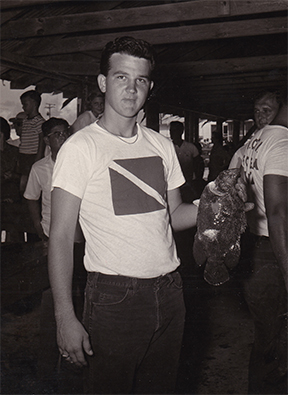
The pic is of Buck and me in 1963. He is holding a Barracuda he shot, and I am holding an empty speargun for the one that broke my line. We switched to stainless steel cable after that.

Leave a comment

Filed under Growing Up, Kenner

Here kitty, kitty…

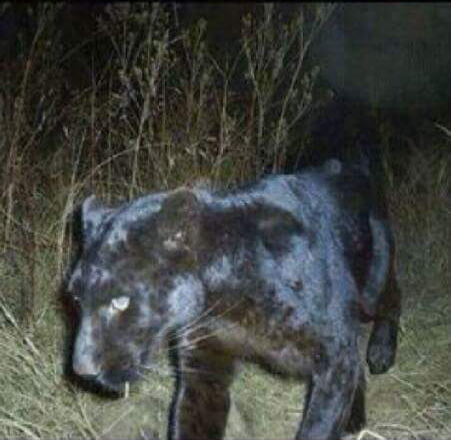
pantherI found this image of a panther on Facebook. Look closely and you can see it is a black variation of a spotted panther. You can see the spots on his foreleg. Folks say they don’t exist in Louisiana. Well, supposedly this game camera image was taken in Louisiana. (For the uninformed, game cameras are set up in the woods, usually strapped to a  tree along game trails or looking over automatic deer feeders. They take a picture automatically when the sensors pick up the evidence of something moving nearby.)

Panthers are indeed out there, but sightings are extremely rare and usually at a distance where it could be argued what was seen was something else, like a deer or a hog, or even a big house cat. But I know two people who have seen panthers.

One was my friend Sharon P. She saw hers in south Mississippi—close to Louisiana, right? Sharon is an avid hunter and has trophies on her wall that would make most any hunter envious. My point is, Sharon is a savvy woods-person and is not prone to hysterics, thus, in my book, if Sharon saw a panther, Sharon saw a panther.

The other sighting I am aware of was by my friend Buck. He was a heavy equipment operator in his early life after discharge from the Army and was working as a dozer operator on the Sunshine Bridge, which was built in the early seventies, if not mistaken. The equipment was stored at night in a marshaling yard some distance from the bridge site, and each morning Buck had to drive the dozer to the work site on a levee . There were cane fields on one side of the levee and woods on the other, if I am remembering this correctly.

This particular morning was extremely foggy with restricted visibility such that you could see only a few yards. He waited for the fog to lift but soon got bored with that and cranked up his dozer and started the trip to the site. Even though the fog had lifted off the ground a few feet, up in the elevated cab of the big dozer, he could see only a few yards ahead, and staying on the levee was difficult.

He got aggravated with that, so, he shut it down and lit up a cigarette and sat there in the dead silence, waiting for the fog to lift.

It didn’t, and he eventually had to relieve himself of his morning coffee, so he stepped out of the cab onto the track of the dozer, then dropped to the ground. Upon landing, he was face-to-face with a black panther.

The cat screamed!

Buck Screamed!

The cat did an about face and took off!

Buck did an about face and took off—but his trip was cut short when he ran smack into the tracks of the dozer. That hurt!

Buck said he spoke to some farmers about this later, and they confirmed they had also been seeing a panther in the area. So, don’t let anyone tell you there are no big cats in Louisiana.

Leave a comment

Filed under Family History, Growing Up

The Brave Rifles

Near the end of my book, The Last Day of Forever, I have my main character, Ethan, as a young second lieutenant in a unit called the 1st Regiment of Mounted Riflemen out in New Mexico Territory. They did exist—and still do. Here are some highlights of what I discovered in my research for this portion of the book and this particular regiment.

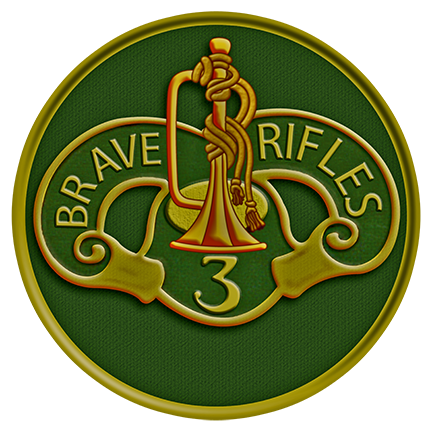
3rd ACR copy

The Regiment of Mounted Riflemen was created as a very early version of a modern mechanized infantry regiment, in a manner of speaking, that is. They were mounted on horses and rode to the fight, but once there, they dismounted and generally fought on foot. They were also issued rifled muskets instead of the usual smooth bore muskets the infantry of that period carried (prior to 1861) or the much-hated Dragoon muskets carried by other mounted troops. The Dragoon muskets were inaccurate, and the ball was prone to rolling out of the barrel if the barrel was pointed downward. In my book, I have the Brave Rifles armed with Sharps carbines. I could not determine if they were actually so armed prior to the Civil War or not. Some mounted units were indeed armed with Sharps during the prewar period, so I took a little artistic license on that point.

The Sharps carbine was a breech-loading weapon (verses muzzle loading, which means it was loaded from the back or breech end instead of the muzzle end). This made reloading much faster and easier, especially on horseback. The cartridges of the early model Sharps were made of paper and contained powder and a bullet. The trigger guard/lever was swung down, dropping the breech block to expose the chamber for inserting the cartridge. Once loaded, the lever was returned to the closed position, and the breech block closed with a sharp edge clipping off the back of the paper and exposing the powder to the priming charge. A primer cap was inserted over the nipple. Pulling the trigger dropped the hammer on the primer, igniting it and in turn the powder charge. Being rifled, they were much more accurate and had longer effective ranges than the other smooth bore arms of that period. Later model Sharps used metallic cartridges that were fully self-contained; projectile, powder, and primer cap all in a brass case. The longer rifle versions of the Sharps became favorites of buffalo hunters. If you ever saw the movie Quigley Down Under with Tom Selleck, it was a Sharps rifle that Matthew Quigley used.

Sharps Model 1853 Military Rifle

1853 Military Sharps

The Regiment of Mounted Riflemen was formed in May of 1846. Under various names, it has seen action in all of America’s major conflicts since then, including The Mexican-American War, The Indian Wars, The Civil War, Spanish-American War, World War I and WWII, as well as service in Iraq and Afghanistan.

It was in the Mexican-American War in 1847 that the regiment got its nickname, “Brave Rifles,” and its motto, “Blood and Steel.” After several major engagements, the exhausted regiment was visited by General Winfield Scott. He had come to order the regiment to Churubsco for an even more difficult battle. He removed his hat, bowed low, and said: “Brave Rifles! Veterans! You have been baptized in fire and blood and have come out steel!” Even today members of the unit greet each other thusly: An enlisted trooper renders military courtesy to an officer by saluting and yelling out “Brave Rifles!” The officer will return the salute and reply just as loudly, “Veterans!”

The regiment is also thought to be the origin of “Gringo,” the modern Hispanic slang for an American. The regimental marching song, which dates back to the Middle Ages, is named “Green Grow the Rushes, Ho!” Legend has it the Mexicans slurred the “green grow” into “gringo.”

In 1848 the regiment returned to Jefferson Barracks, MO where it was originally formed, and in 1849 was sent on a grueling march all the way to Oregon Territory. Two years later, they returned to Jefferson Barracks and were officially designated as the 1st Regiment of Mounted Riflemen (previously without the “1st” designation) because the Army expected to raise two more such regiments. That never happened.

In 1851 the regiment was ordered to Texas, and in 1856, they moved further west into New Mexico Territory. (Ethan joins the regiment in 1860 and resigns in early 1861.) They had a very large territory to police and never enough troopers to do so.

With the advent of the Civil War, all mounted regiments were organized as cavalry, and the 1st Regiment of Mounted Riflemen became the 3rd US Cavalry Regiment. They fought in the Civil War, mostly in the western theater, first in Texas and later in Missouri, Tennessee, and Arkansas.

In 1866 the Brave Rifles were ordered back to New Mexico Territory to campaign against the Indians.

Old_Bill_Cavalry_Mascot_Poster

In 1898 the Brave Rifles arrived in Tampa, FL for deployment to Cuba during the Spanish American War. The famous western artist, Fredrick Remington, was visiting the regiment’s camp. One of the regiment’s NCOs, Sergeant John Lannen, caught his attention as representing what Remington considered to the epitome of the American cavalryman, and he sketched him. The drawing eventually became known as “Old Bill.”

During World War I, the regiment deployed to Europe and saw only limited action, but during WWII, they traded in their horses for armored vehicles and were reorganized as the 3rd Armored Cavalry Regiment, serving in Europe. It was troopers from Troop B, Reconnaissance Squadron of the 3rd ACR that were the first Americans to cross into Germany, albeit only a short excursion to prevent the Germans from blowing a vital bridge.

The Brave Rifles served in Iraq during Desert Storm. In 100 hours, they covered over 300 miles, rolling over three Iraqi divisions in the process. They also served in Bosnia and more tours in Iraq and Afghanistan.

In 2011 they were renamed yet again as the 3rd Cavalry Regiment and traded in their heavy armor for lighter and faster Stryker armored vehicles. They are currently based at Fort Hood, Texas.

Leave a comment

Filed under Catahoula Books, Civil War, Firearms, History Lessons, Last Day of Forever