Kenner, Kids, and Go-Carts

Or better known as “hell on wheels.”

We were mostly young teenagers then and before we were allowed to drive a car or even begin learning how to drive a car, but we wanted to drive something. And just in time along came the go-cart craze. Joey Giammalva was the first on the block to get one, followed by Manard Lagasse. I think I was next, followed by Bobby Manard.

We had an interesting variety of go-carts. Joey’s and mine were the same model with a two-stroke engine, which required mixing oil with the gasoline. It was low slung and fast looking, with the emphasis on the “looking” part.

Manard’s go-cart looked more like a soapbox racecar stripped down to the skeleton without the outer body. It was long and not as wide as the ones Joey and I ran. Manard’s “soapbox” go-cart was powered by a four-stroke engine, and this resulted in long heated discussions on the merits of two-stroke verses a four-stroke engines, the precursor of later heated discussions on the merits of Chevy verses Ford engines when we graduated to cars.

My cousin Bobby’s go-cart was a two-seater, which I suppose was so he and his older sister, Melanie, could ride at the same time, although I don’t recall Melanie ever showing up with the “go-cart gang.” And Boo, my uncle and Bobby and Melanie’s dad, generally restricted Bobby’s go-cart activity with us older kids. When Bobby got the “keys” to the go-cart and joined us, he was just as bad as the rest of us, confirming his father’s suspicions.

Several other neighborhood kids also acquired go-carts, and one was Al LeBlanc who lived way over on Compromise Street. Getting together required someone traveling across Kenner and subsequently getting the unwanted attention of the Kenner police, since we usually used streets to get around when sidewalks were not available or inconvenient, and they were rarely convenient. They harassed us for a while but eventually gave up; I suppose resigned to the “fact” one of us would eventually get run over by a car and scare the rest into staying off the streets. Fortunately, that never happened, although we did have a few close calls.

Real helmets were non-existent then. We improvised with Army surplus helmet liners from WWII, which offered the barest minimum of protection. We used them mainly because they looked cool. Most of us painted them white, which did make us a bit more visible to motorists, and Ralph Marino painted clever names and logos on the front for us. I was “The Cheetah,” and my logo was a hand of cards comprised of five aces. Wish I still had that helmet!

As red-blooded American boys are wont to do, we pushed our go-carts to the limits. How fast can we go was the first question to find an answer for? We soon discovered they had two speeds: full-speed-peddle-to-the-metal and stop. If we weren’t stopped and jaw-boning, we were going full-speed-peddle-to-the-metal somewhere, which was around 20-25 mph. That was a guess, since none of us never actually clocked our go-carts to find out. Races were a common occurrence in the beginning, but since we were not modifying them to go faster, the results were always the same unless someone cheated. Racing soon got boring.

So instead of racing, we challenged each other to do stupid stuff with our go-carts. When we got older, this would be characterized by the phrase “hold my beer and watch this.” If we could find anything even remotely resembling a hill from which we could launch ourselves, we would see if the go-carts could jump. Actually, they do though not very well and landing was hard on the spine since they were not sprung. We discovered if we got up to full speed then jerked the steering wheel to one side or the other while we locked up the breaks, which were only on the rear wheels, we could do a 180 spinning turn, kind of hard on the tires but fun.

Unfortunately, this trick sometimes had unintended results. Once I led the pack doing this in the middle of Minor Street with Manard in his soapbox go-cart behind me. I stopped after accelerating out of my 180 turn and looked to my right just as Manard’s go-cart puttered past me—minus Manard. He was sprawled out on his back in the middle of Minor Street where he fell off while doing the 180 turn.

Another “fun” thing we did was mix go-carts with roller skates, but that is another (painful) story that will follow soon.

When I got older, and the go-cart craze wore off, MB removed the engine from mine and modified it with bicycle peddles for my two younger sisters to use. MB got the gearing wrong. The girls had to peddle like crazy to get the thing to even move at a snail’s pace. They were exhausted just going twenty feet, but maybe that was his intention. And thus was the ignoble end of my beautiful go-cart.

But that was OK with me; I had graduated to cars! Did you know you can do with cars a lot of the things you can do with go-carts? A lot, but not all.

4 Comments

Filed under Family History, Growing Up

The Last Day of Forever – Excerpt 2

Here is another short excerpt from The Last Day of Forever.  Enjoy.

Rachel’s Diary

7 June 1856

This is the first entry in my diary since my mother passed away almost a month ago. My life has changed in so many ways I cannot even begin to comprehend what all this will mean for me. I need to record my thoughts, and maybe that will help me sort things out in my mind.

I’m on the sternwheeler “Shreveport Belle” headed up the Mississippi River from New Orleans bound for Catahoula Plantation on the Red River. I found a place where I can have privacy to work on my diary, a comfortable bench in front of the wheelhouse with a marvelous view of the river.

My mother’s passing was the most profound change in my life. She was my life, especially the last months she was alive, her health slowly declining, rendering her incapable of even the most basic efforts without my assistance. During that period, we became even closer than we were before. We laughed together and we wept together as we attempted to get through her terribly painful sickness.

It was hard watching my mother die, watching her deteriorate from the vivacious and loving woman I knew most of my life into the empty shell she became. In some ways, I am not yet accepting of it. I have not wept for her, not even at her funeral. I was numb, feeling nothing, as if my emotions were depleted, and I was incapable of expressing them. The hurt in my heart would not come out for me to find relief from it.

More changes came in my mother’s last days when an old friend of hers showed up, summoned by her. Morgan Davis was a friend of my long deceased father. My mother had written Uncle Morgan (as I was asked to call him) when she realized her remaining time here on earth was drawing to a close. They had not seen each other since before I was born, and they must have been close since she asked him to take responsibility for me.

When Uncle Morgan first arrived at our home in Virginia, my mother asked to be alone with him. I waited outside and could hear them talking about me. Sometimes they got quite loud, though not enough for me to understand all they said, but I knew my future was being decided in that room.

My mother called me in after they had spoken and explained what was about to happen to me. I was to be given to a complete stranger and taken away to his plantation in Louisiana–a place I knew nothing about–and joined to a family I had never met. That’s when the full impact of my mother’s pending death hit me for the first time. That’s when the fear first set in.

I looked up at Uncle Morgan, and he seemed as confused and distressed as I was, though he tried to hide it with a reassuring smile.

With my future thus settled, my mother died a few days later.

Leave a comment

Filed under Catahoula Books, Excerpts, Last Day of Forever

The Last Day of Forever – Excerpt 1

What follows is a brief excerpt from chapter 1 of The Last Day of Forever, which I hope to have published in early February. Enjoy.

*****

Cover B1CRed BlogI awoke with a start, drenched with sweat, and breathing hard as I tried to orient myself. The room was in semidarkness with only a weak light coming through the small round window above my head. All was quiet except for the throbbing, mechanical sounds of a steam engine. A riverboat? “I’m on a riverboat,” I said softly to myself with a sense of relief. “I’m on a riverboat on my way to New Orleans.”

My breathing slowed as I swung my feet out of my bunk and onto the floor. That dream, I had not had it since I was a young boy. Why now? I thought. Why now?

I dressed myself and joined my mother, Analee, for a breakfast of eggs, bacon, grits and biscuits prepared by Mabel Honeycutt, the captain’s wife.

“You sleep well?” my mother asked as I took my seat at the table.

“Tolerable,” was my noncommittal reply. I did not bother to tell her about the nightmare, as she would only have reminded me it was just a dream like she did when I was a child. “Sarah up yet?”

She smiled. “You didn’t expect her to be, did you?”

I shrugged. “Brandy and Zeke get fed?”

“A little while ago,” she replied before taking a sip of her café au lait.

I pushed my plate aside, its contents half eaten.

“Something wrong, Ethan?”

“Nothing. I’m fine. I’m going topside,” I announced before pouring a tin cup of black coffee and heading up to the hurricane deck, my refuge on these trips on the Shreveport Belle.

“Morning, Ethan,” said Captain Honeycutt when I entered the wheelhouse.

“Morning, sir. When do you think we’ll reach New Orleans?”

“Early afternoon.” He gestured at the river with his ever-present corncob pipe. “The Grand Ole Lady is high and fast with a strong spring runoff. We’re moving right along.”

Captain Jonathan Honeycutt knew the river as well as any man alive, both the Red and the Mississippi. He was mostly soft spoken with a quiet manner about him, but perfectly capable of making a deckhand think the wrath of the Lord was upon him if he did wrong. He was also a student of the Bible and frequently quoted verses from memory. Being something of a student of the Scriptures myself, we often discussed the Bible when I had occasion to travel on the Shreveport Belle. But not this morning as I wanted to be alone to clear my head. I excused myself and took my cup of coffee and found my usual seat on the bench directly in front of the wheelhouse.

On my little bench high above the activities on the decks below, I had a commanding view of the Mississippi as we churned south to New Orleans. And it was peaceful there, with only the reassuring throb of the steam engines and an occasional whistle greeting between passing riverboats. I stretched out, crossed my legs and leaned against the back of the bench while I sipped my coffee and slipped into my thoughts.

That dream was still troubling me. Even though it had been a many years since I last experienced it, I knew in my heart it meant something. If nothing else, it had influenced how I felt about the “peculiar institution” of slavery.

There were other troubling “peculiarities,” so to speak, such as Brandy, my mother’s personal servant. Her mother was Martha, our mammy back at Catahoula Plantation. Mammy was very light skinned, some said at least a mulatto and maybe even a quadroon, having the white blood of some previous owner flowing through her veins. Brandy was as white as I was, even lighter, considering I was usually sun burnt from the performance of my chores caring for the animals at Catahoula and providing fresh game and fish to add variety to our meals. She was not only fair, but also very comely with dark hair and hazel eyes, and the smoothest skin I have seen on any woman. We were like brother and sister, as she was born the same day I was.

She more lived the life of the pampered daughter of the plantation owner, and it was whispered among the slaves that Brandy’s father was Morgan Davis, my mother’s husband. That would indeed make her my half-sister. When I asked my older half-brother, Peyton, about that, he only warned me not to listen to the tales the darkies tell. But I could not escape the feeling that Brandy was a slave trapped in a white woman’s skin, a foot in each world and a member of neither.

I shook my head as if to rid it of those thoughts­­—and that dream. But I could not shake the feeling that my life was about to change, and I admit I was a bit anxious about that. Some of that change was expected, as I would soon turn eighteen and be off to school at the Virginia Military Institute. This would be my last summer of adolescence. But another change loomed, one I was unsure of, because Morgan expected me to play an important role in it, one I was not all together comfortable with.

It began almost two months before when Morgan received a letter from someone he had not seen in over 14 years. As I entered his office that day, I noticed the concerned expression on his face as he read his mail at his desk. “Something wrong?”

He leaned forward in his chair and continued reading as if he had not heard me. His expression grew ever more grave.

“Father, is something wrong?”

He put the letter down on his desk and looked up but said nothing. Instead, he stared blankly and unfocused as if bewildered and struggling to comprehend what was troubling him. He shook his head as if to relieve his confusion then looked at me. “I just received some bad news.”

“What happened?”

He paused as he continued to struggle with his thoughts. “Do you remember me speaking of my friend from Virginia, John Whitcomb?”

“He died a long time ago as I recall.”

“Indeed, fourteen years ago. He left a widow and an infant daughter by the name of Rachel. Right after it happened, Jenny, his widow, wrote and told me about his death and the child. This was after I lost my bid for re-election to the House.” He paused and took a deep breath. “Well, I just got this letter from Jenny—and she’s dying.”

I knew there had to be more to it than that, and there was.

“She wants me to come to Virginia right away, before she passes, and take her daughter as my ward to raise as my own.”

*****

3 Comments

Filed under Catahoula Books, Civil War, Excerpts, Last Day of Forever

The Ditch

I don’t know what it is about ditches, but they held a peculiar fascination for us when we were kids, and we had plenty of ditches to be fascinated with, as there were very few enclosed drainage ditches in Kenner. Most of them were open scars in the earth. We had little tiny ditches only maybe a foot deep and a foot or two wide, and we had bigger ditches that were three or four feet deep and just as wide or wider. And then we had at least one ditch along the IC tracks that was bordering on canal size. It was an easy eight feet deep and about ten feet wide. It always had about a foot of flowing water in it even when it had not recently rained.

Since there was no central sewerage system in Kenner back then, most homes had cesspools, which eventually drained into the ditches. That meant those ditches closest to homes might have some pretty dark mud in the bottom. We tended to avoid those. Even though we spent a lot of time fooling around in ditches, none of us got sick from it, not even Kibby Manard who seemed to always be falling into the ditches with the blackest cesspool mud. And then, maybe we never got sick because my dad gave all of us kids tetanus shots about once a week, or so it seemed.

Once we even found a small alligator in the ditch on the corner of Sixth and Minor Streets. Snakes, crawfish, and eels were common. The clear water of the IC ditch held lots of small fish, including some that looked to me like the fantail gourami fish you bought in the pet shop for your aquarium. Once I decided to “fish” in the Minor Street ditch beside my grandfather’s house. I used a stick I found in the Joe Lorio’s woods for a rod, with some cotton string and a safety pin. I forget what I used for bait, probably bread, but I “cast” my line into the ditch kind of under the culvert for my grandfather’s driveway, and dang if I didn’t get a bite! It was a big old eel, and he broke my “rod.”

But there was one ditch that was special to us. It was so special, that to this day, my cousin Bobby reminds me of it almost every time we get together for some family gathering. That special ditch would be the one in front of my grandfather’s house alongside Sixth Street. It was “Our Ditch.”

Three things made it special? The first was its shape. It was a shallow ditch only about two feet deep at the most and about four to five feet wide with gently sloping sides. The second feature was that it was lined with St. Augustine grass, which was the grass most everyone planted in their yards and was, of course, in my grandfather’s yard. The ditch was merely a slightly sunken extension of his front yard, and they mowed it just like the rest of the yard. The third feature that made it special was that it was almost always dry. It filled only during rainstorms and then quickly drained and dried out again.

If you have been paying attention, you may have noticed that, with the soft grass lining and sloping shape, this ditch was shaped an awful lot like a lounge chair, which is exactly how we used it. After a game of baseball or football in the empty lot across the street, or building forts in Joe Lorio’s wooded lot between my grandfather’s house and the Manard’s house, we would end the day lounging in Our Ditch just talking and enjoying the sunset.

Bobby keeps telling me he wants to go back to Kenner and lay in that ditch again. I am not sure how the current owners of my grandparent’s house would feel about that. Besides, it has long since had culverts installed and covered over. Yet another piece of our childhood lost forever. And to think, our great grandkids will never have the sublime experience of watching a sunset from a grass-lined ditch shaped like a lounge chair. Such is modern life.

5 Comments

Filed under Family History, Growing Up

Growing Up in Kenner

My cousin Bobby keeps reminding me we grew up in the greatest place in America and during the best time in America’s history. He may be right. Where exactly is this “greatest place” to grow up and when was that “best time”?

According to Bobby, and I agree, “where” was Kenner, Louisiana. It is now a suburb of New Orleans, but when we were kids, it was a small mostly rural community about 10 miles west of downtown NOLA. Kenner was far enough away to be somewhat isolated from the “city” and retain its small town feel, but that was changing even back then.

The “when” part was during the late 1940’s through the early sixties. But like many communities around America at that time, Kenner was experiencing a post-war boom that would forever change its rural, small community feel to a large almost characterless suburb. Back then Kenner had character, lots of it, and a lot of characters, as well.

Kenner is a fairly old city with a long history. LaSalle landed there in 1682 and the town was founded by Minor Kenner in 1855 on land that consisted of three plantation properties that had been purchased by the Kenner family. At the time, all land north of what is now Airline Highway (excuse me–Airline Drive) was swampland.

The population today is around 66,000, but when we were kids I remember the number 12,000 being tossed around. That would have been in the fifties.

Kenner today extends from the Mississippi River north all the way to Lake Pontchartrain, about six miles. It is bound on the west by St Charles Parish and on the east by Metairie and the unincorporated areas of Jefferson Parish. When I was a kid it was much smaller. While the east/west boundaries were already well established and north of Airline Highway had been drained as the city grew northward, everything north of what is now Veterans Boulevard remained swamp or land used for farms or grazing cattle. Williams Boulevard was a gravel road from about Veterans to the lake.

The most important feature of Kenner is the airport, called Moisant Field or Moisant Airport back then but now called Louis Armstrong International. The airport was carved out of drained swamp and built by a company out of Chicago, if I am remembering the story my father-in-law told about its construction. He claimed those Yankees were so stupid they used Kenner Mapthe very large and heavy bulldozers instead of smaller lighter ones to clear the drained land. They returned to work one morning to discover several had sunk out of sight into the muck. At least that is the way he told it.

But back “when” Kenner was the “greatest place” in America to grow up, it was just a small town with a main street (Williams Street, which became Williams Boulevard at Airline Highway Drive) and a CBD all of three blocks long. It was a bit longer until the Mississippi claimed a couple of blocks, and Third Street became the street closest to the levee. First and Second are in the river now.

The Kenner I knew is now called “Rivertown,” but we stick with “Old Kenner.” It extended from the river to Airline Highway, a distance of six blocks and two railroad right of ways. The one closest to the river was the Southern Pacific and the one along Airline Highway was the Illinois Central. I grew up between the two tracks on what was Sixth Street (now Toledano Street) and Williams Street, five blocks from the river.

Side note: My wife grew up a block away on Minor Street. My wife’s dad was one of nine siblings, and he claims those tracks were the reason he had so many brothers and sisters. They lived in a small three-bedroom house about halfway between the two sets of tracks. With so many kids and adopted cousins living with them, some slept in the bedroom with the parents. When a train came through in the middle of the night, usually shaking the house, Poppa would wake up Momma and—well, you know? New sibling on the way.

When I was a kid, Kenner, Louisiana was a small farming community of around 12,000 people. Many citizens of Kenner were of Italian descent and many of them were small truck farmers who would bring their produce to town where it would be packed and shipped north by rail. My future wife’s family ran the local produce packing shed and ice house that supplied the ice for this process.

Like most small towns, everyone knew everyone else, at least on the Airline Highway Drive side of Kenner. Many of my teachers lived within a few blocks of where I lived, so it was hard to get away with anything at school. The fact that my grandfather, Stephen J. (Buck) Barbre, was the principal also contributed to that. If I got into trouble in school, my mother knew about it long before I got home.

Kenner was a safe community, and doors were rarely locked. At night in the summer, we slept to the soft roar of an attic fan sucking in the cool night air through open windows. Air conditioning didn’t come along until the late fifties for most of us.

I feel sorry for kids today. My son won’t let his daughter play outside alone, and they live in what most would consider a very safe neighborhood. It wasn’t like that back in the fifties and sixties. We came home from school, changed clothes, and disappeared into the neighborhood. Our parents never knew where we were, and we were never in any danger, except to ourselves because of some of the stupid things we did. We sometimes stepped on a nail—tetanus shot. Cut a foot or hand on a piece of metal—tetanus shot. Burned a finger with a match or firecracker—tetanus shot. Fell in the ditch—tetanus shot. My dad, the town doctor, dispensed so many tetanus shots and penicillin shots we were probably immune to every disease known to man. We lived through it, even thrived, and we certainly had fun, and our parents worried very little.

We never had any formal playgrounds. The whole world was our playground. Unless it was raining, we were outside, and even when it was raining, we were sometimes outside. And we stayed outside until it either got dark, or a parent rounded us up.

Our homes had fairly large yards but only rarely were they large enough to contain our activities. We needed and sought more room and more varied topography to play in, and in Kenner back then there was plenty of variety. In my neighborhood alone, I could count three heavily wooded lots to play in, two quite large, plus several open fields, one of which was a full square block. And that was within two blocks of where I lived.

We could play cowboys or army and build forts in the wooded areas, or play football and baseball in the open fields. We always had some place to play, and our parents were never overly concerned about us or where we were, since we were usually within shouting distance.

For organized sports like football or baseball we had at least two immediate choices. There was an open field on the corner of Sixth Street and Minor Street. It was plenty large enough for us to use for baseball and football until we grew old enough and strong enough that it became too confining and risked putting a baseball through someone’s window. No problem—when we needed larger we had a whole city block to play in and only a block away. Our Lady of Perpetual Help School now occupies that block. When we were growing up in Kenner it was completely unoccupied by any permanent structure.

Kids love the woods, and we had plenty of wooded lots to choose from. When we were really young we had Joe Lorio’s wooded lot between my grandmother’s house and the Manard’s house. It was small but large enough we could hide from parents and do kid stuff in it. We also had the key lot behind the double belonging to the Manards and the Legasses. It was only lightly wooded but remote enough to be a wonderful playground. Next door was a huge (to us) wooded lot facing Williams Street. When we were old enough to be allowed machetes and hatchets, we chopped down small trees in that lot and built forts in the Manard’s key lot.

One year they bulldozed most of the trees on that lot and pushed them into big piles and left them there like gracious gifts for us kids to play in. We scampered over those piles of trees with our hatchets and machetes and built even bigger forts to play army in.

Every summer the Manards would bring in a load of spillway dirt and dump it in the key lot, and they allowed us kids to level and spread it for them. That process started with “dirt wars.” There was enough clay in the dirt we could make balls and throw them at each other like snowballs. And they hurt! Then we dug small tunnels and built little villages in it to play with our toy trucks and cars in it. After play we all went home covered with river sand and tracked it into our respective houses. My mother hated those dirt piles! I usually had to undress in the garage.

On Minor Street near the IC tracks, two blocks from my home, was another wooded lot. Beside it was the closest thing we had to a creek in our little world, a nice deep ditch with flowing clear water containing small fish and crawfish.

In the summer our “uniform of choice” was shorts – period – no shoes, no shirts. That was from the end of school in May until it stared again in September. At the beginning of summer, our feet were tender and sensitive from a year confined to shoes, and our skin was pale white. By the end of summer our feet were so calloused we could run across the clamshell-covered streets and feel no pain, and we were nearly as dark as some of the African-Americans in Kenner.

We had no TV. The elderly Manards were the first to get a TV in our part of Kenner. Why them, I have no idea? We had one or two stations broadcasting only a few hours a day. It was a novelty for us kids, but outside was far more interesting.

Though “unique” to us, I imagine Kenner was pretty much like many small towns in America just after World War II. It was indeed a great time to be a kid, and Kenner was a great place to grow up.

Some of what I will be writing in this blog will be short “remembrances” from my childhood. Mostly they involve me and my family and friends. I will try to keep them light and humorous. I intend for this to be a WIP (Work In Progress), as I remember more stories or my cousins and friends remind me of things I have forgotten. When I accumulate enough, I will publish them as a book. I hope you will enjoy reading about them as much as we enjoyed living them.

The next post on this subject will be a story that sort of started this, and that was Bobby reminding me of how much he loved The Ditch.

5 Comments

Filed under Family History, Growing Up

The Last Day of Forever

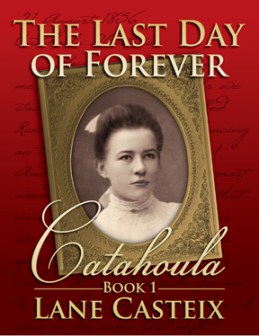
Cover B1 In 2013 a mysterious old trunk is unlocked to reveal its long-kept secrets: diaries and a manuscript that tell the 160 year-old love story of Rachel and Ethan in antebellum Louisiana.

Orphaned, Rachel is thrust into Ethan’s family, one she doesn’t know, in the care of a man she never met, and taken to Louisiana, far from the Virginia she is familiar with. Bewildered and afraid, she finds comfort in an unexpected new relationship.

In a family caught in the throes of lies, infidelity, death, and eventually the Civil War, Ethan is struggling with changes in his own life, and with his faith. In 1856 he is just beginning his last summer of adolescence at Catahoula Plantation before going off to school at the Virginia Military Institute. Falling in love was not part of his plans—until Rachel came into his life.

Spirited and daring, she is unlike any woman he has ever known. He didn’t expect she would turn his world upside down like she does, nor did he anticipate how strongly his father would react to how they feel about each other, or the extremes to which he will go to keep them apart.

Leave a comment

Filed under Catahoula Books, Civil War, Last Day of Forever

Catahoula Genesis

December 2013

New Orleans, Louisiana

The old camelback trunk in my mother’s attic had always intrigued me. When I asked about its contents, she said it contained “just some old books and papers.” It originally belonged to my grandmother and had belonged to her mother before that. Past those generations its provenance was uncertain.

With my mother’s passing, the old trunk belonged to me. Unfortunately, it was locked, and there was no key to be found. Not wanting to destroy such a fine old trunk just to satisfy my curiosity, I tucked it into a corner of my attic with the expectation I would eventually find the key somewhere in my mother’s possessions. There it sat, forgotten for nine years.

That changed when I was cleaning out some files that included my parent’s old income tax filings. A strange lump at the bottom of one of the folders turned out to be a key, and my first thought was, this is the key to the trunk!

I went immediately up to the attic and pulled the old trunk out of its corner. I was more than a little apprehensive about what I might find when I opened it. Did it contain some dark family secrets that should remain locked away? After mustering up my courage, I inserted the old key. It fit, and the lock loosened its hold on the old trunk’s secrets.

My mother was right. It did contain some “old books and papers”. The “books” were the personal diaries of a woman named Rachel. The “papers”, nearly two thousand handwritten pages, were secured in four neat bundles with red ribbon. They turned out to be a manuscript written by a man named Ethan. I also found a portfolio of drawings by Rachel and bundles of letters they had written to each other. The documents dated from five years before the Civil War through its end in 1865 and a few years after.

With only a cursory examination of the trunk’s contents, I realized I was in possession of something very special. The diaries and the manuscript, though written by two different people, were companion pieces telling the same beautiful story from two different perspectives.

Catahoula Book 1 – The Last Day of Forever tells how they met, how they fell in love, and how their love was challenged. It carries their story up to the start of the Civil War.

The Legend of Rachel and Ethan continues in Catahoula Book 2 – An Eternity of Four Years, which takes their story through the turbulent years of the Civil War.

Their story is told in their own words taken from his manuscript and her journals.

1 Comment

Filed under Catahoula Books, Civil War

Maw Maw and Me

How many of you can say you have actually had conversations with someone who was alive during the War Between the States?

I can.

My great grandmother was born on Christmas Eve of 1861 in that part of Catahoula Parish that became LaSalle Parish when it was created from the western half of Catahoula Parish in 1910. She died just before Thanksgiving of 1964, just short of 103 years old. I was 20 at the time of her death.

She lived the winter half the year with my grandmother in Kenner and the summer half with another daughter in Shreveport. We had many conversations when she was staying with my grandmother, mostly about the war as that was of interest to me even when I was very young. Of course she was really too young during the war to remember much of it, but she told stories that were told to her by her mother and her father, who served in the Confederate Army, and some of her life after the war. Wish I had written all those conversations down.

One of her stories appears in An Eternity of Four Years*, but I changed it slightly. Here is the original.

During the war, with the men off fighting, the women had to run the plantations, farms and homes. Maw Maw spoke of growing up on a plantation, but it may have been no more than a moderate size farm for all I know. But they did own slaves, and one had become particularly malodorous because of his neglect of good hygiene practices. My great-great-grandmother took it upon herself to do something about that and presented the offender with a bar of lye soap. She then proceeded to tell him what to do with it.

“You go down to the creek and wash yourself. Start at the top of your head and scrub all the way down as far as possible. Then start at the bottom of your feet and scrub up as far as possible. And when you’re finished, give ‘possible’ a good scrubbing, too!”

My great-grandmother’s name was Martha Allen Davis, no relation to Morgan Davis, and evidently, no relation to Jeff Davis, either. She married Greg Negles Boddie, also of Catahoula Parish but originally from South Carolina. He died before I was born. They had nine kids.

I don’t remember her ever walking without the aid of a crutch, just one. She had fallen and broken her hip sometime before I was born. She would have been about 82 (or younger) when it happened. In those days, if you were unfortunate enough to break a hip, you gutted it out and healed—or died. She healed, but it left her lame. She used a slop jar at night, so she wouldn’t have to struggle to the bathroom, which was just outside her bedroom door.

She lived in her bedroom most of the day, coming out for meals or to join the family in the living room or back porch for conversations. Her bedroom was quite large. She had a rocker in one corner where she “held court.” The rest of us pulled up a chair or stool to talk to her. I asked questions, and she continued tatting while she answered, usually with an amused chuckle as she did so.

Her favorite candy was those sugar coated, gummy orange slices. She had no teeth but would suck the sugar coating off and gum the gummy part that remained. She always had a dish of those candies on the table beside her rocking chair. To this day, they are one of my favorite sweets, and every time I eat one, I think of Maw Maw.

She was born in the days of the horse and buggy, when steam engines were the latest technology, firearms were mostly single shot muzzleloaders, and lived through to 1964 and the age of automobiles, airplanes, and nuclear weapons. Amazing! Wish I had thought to question her about how that felt.

Hers was the first death that affected me emotionally. I wept at her funeral. Maw Maw is buried next to Paw Paw in Jena, Louisiana, the parish seat of LaSalle Parish.

*An Eternity of Four Years is Book 2 of the Catahoula Chronicles, a novel about two people who fell in love in antebellum Louisiana. The Last Day of Forever is Book one of the series and tells their story up to the beginning of the war. An Eternity of Four Years continues the story through the war. Both will be published soon.

1 Comment

Filed under Family History