Monthly Archives: May 2015

The Last Day of Forever Update and Excerpt

Book 2 1Moving right along with the printed proof of An Eternity of Four Years, the exciting conclusion to the Catahoula Series. Not making promises, but looks like it will be available as soon as three weeks from now. You have seen two previous excerpts from An Eternity of Four Years here and here. This scene takes place during the battle of Port Republic in the Shenandoah Valley in 1862.

 *****

Taylor summoned me early the next morning, Sunday, 8 June, and I was given some dispatches to deliver to Jackson in Port Republic. I saddled Pepper and rode out of camp and headed for Port. The dawn was breaking clear and promised a day without rain for a change. I soon arrived at Port, crossed the North River bridge, and made my way down Main Street to Jackson’s headquarters at the Kemper Estate at the far end of town.

I was not more than two squares down Main Street, when I heard the unmistakable scream of an artillery round overhead. I looked up and, to my utter shock, saw the shot falling directly towards me! There was no time to do anything but close my eyes in preparation for meeting my Maker. It crashed into the street right between Pepper’s legs and exploded with a deafening roar, knocking both Pepper and me to the ground.

I rolled clear and could do little more than lay there stunned by the blast with my ears ringing. Pepper struggled to his feet screaming to wake the dead. From the sounds he was making, I was sure I would find his gut torn open, and I would be forced to end my noble steed’s agony with a shot from my Colt. My terror-stricken warhorse found his footing and bolted like a cannon shot in the direction from which we had just come. I rolled over and looked up the street to see my faithful mount deserting under fire. He slowed just long enough to decide he wanted nothing to do with that bridge and turned left and headed up the road following the North River. I whistled for him to come to me, but he did not stop and only whinnied back in answer, which if it could have been translated into English, I am sure he was saying something to the effect that I could go straight to the Devil. I figured, if he could move that fast, he couldn’t be hurt all that bad, and I turned my attention to my own wounds.

To my immense relief, I found only a minor scratch on my left forearm. Except for that and ringing ears, I was unhurt. Meanwhile, I heard another round coming in and turned over onto my belly, covering my head with my arms. It exploded down the street, and I scrambled to my feet to get away from my exposed position. The second round was followed by two more, one of which slammed into the steeple of a church we were using as a hospital.

As I stood, I saw Federal cavalry crossing the Upper Ford and cursed Pepper for leaving me there like he had. Our own cavalry were in retreat and scampered through town in their haste to get away from the advancing Federals and very nearly ran me over in the process. I ran up Main Street as more artillery shells careened into the town. I took cover near the church, and Jackson came riding by. Doctor McGuire was busy loading wounded into wagons and swearing at the slow moving orderlies, as was his usual manner. Stonewall reined in his mount and admonished the doctor, “Sir, don’t you think you can manage these men without swearing?” McGuire nodded and promised to try. Satisfied, Jackson spurred his mount into action and headed for the bridge at a gallop. Most of his party barely escaped capture and crossed the bridge just as Federal cavalry entered Main Street at that end of town. Colonel Crutchfield, Jackson’s artillery chief, was not so quick and was taken prisoner only to escape later.

I drew my revolver and prepared for a fight as Union cavalry thronged the bridge end of town. Soon two cannons were brought up and unlimbered at the entrance to the covered bridge, their muzzles pointing across the river. I figured we were in a real fix then. Jackson and his army were across the river, cut off from their escape route by Union artillery and cavalry sitting on the only bridge. I knew I couldn’t storm their position alone and wasn’t doing any good staying where I was. I figured the Federals would surely go for the supply train sitting conspicuously out on the road at the other end of town and made my way toward the Kemper Estate as fast as my legs would carry me in the hope that I could find others with whom I could make a stand.

In Kemper’s yard, I found Captain Sam Moore of the 2nd Virginia and his small company of only twenty muskets, which had been assigned to guard the fords. He was preparing to make a stand at the Kemper house and had already placed his company along a plank fence that surrounded it. I attached myself to this small band, and we set ourselves for the charge that was sure to come. We had not long to wait. Blue Coat cavalry came up Main Street at a walk and turned the corner headed straight for Kemper’s house and our ambush. We crouched behind the fence and allowed them to get closer. When he felt they were close enough, Moore stood and yelled, “Fire!” And twenty muskets barked. I stood and fired with them. The startled Yankees never knew what hit them, and we emptied numerous saddles. They retreated in haste back up Main Street but began regrouping for another go at us.

Captain Joseph Carrington and his Charlottesville Light Artillery with a battery of two guns joined our little group. Carrington ordered both guns unlimbered moved them closer to the fence. He loaded with double canister as the Federals came up Main Street towards us. Carrington hadn’t the time to take down the boards on the fence in front of his guns. He aimed them as best he could, point blank, and moved to rip down the boards. “Leave them,” I yelled. “Just shoot through them!” He nodded and stood by his pieces, as the Yankees came at us again, at a gallop this time. With a jerk of the lanyards the two guns roared, blowing big holes in the fence boards, and we fired with pistol and musket, emptying more Yankee saddles. Once more they retired in disarray, leaving more dead and wounded on the street.

Major Dabney of Jackson’s staff arrived from the Kemper house and did little but encourage us. Carrington limbered up his guns and moved them closer to the river for a shot directly down Main Street. Moore and the rest of the infantry moved to support the guns. The Yankees charged again, and once more we let them have a taste of canister and Minié. The canister swept the street and sent the survivors running for cover at the far end of town.

Across the river, the 37th Virginia Regiment, under Jackson’s instructions, was preparing to assault the covered bridge, while the Rockbridge Artillery pounded the Federal positions from the far shore. Meanwhile, Taylor had been ordered to bring his brigade on the double quick. At least a regiment of Federal infantry was moving for the fords, but artillery fire personally directed by Jackson from the far side of the river forced the Federals to quit their positions at the covered bridge, abandoning their guns just as the Virginians charged. To my astonishment, the retreating Federals failed to burn the bridge. Had they done so, the events of that afternoon and the next day might have turned out very differently.

We pushed them back across the fords, and our artillery pounded their retreating ranks. We had won the day. That surprise attack could have been a disaster for us had they burned that bridge and separated Jackson and his army from his supplies.

The brief little fight over, I was standing near the Kemper’s house fence reloading my Colt, when I heard a familiar whinny and looked up to see my wayward steed standing there, looking for all the world to be as contrite as the most repentant sinner on a Sunday morning. “So, you came back! Skedaddled and left me to face a Yankee horde alone!” I fairly yelled at Pepper. He whinnied and shook his head as if he understood what I was saying and was making his defense.

I didn’t know it at the time, but Jackson had returned and was witnessing my outlandish verbal attack on my horse. “Cowardice under fire! Ran from the enemy you did! I cannot believe that you would do such a thing to me after all I have done for you!”

Pepper snorted forcefully, and I heard laughter coming from behind me. I turned and saw Jackson and his staff watching the show and realized what a spectacle I was making of myself by talking to a dumb horse in such a manner.

Jackson’s expression was as stern as ever. “Shall I have him court marshaled, Captain?” asked Old Jack without cracking a smile.

I grinned sheepishly, and I know I was red in the face. “No, sir,” I replied. “It’s the first time he ever did that. With your permission, I’ll give him a chance to redeem himself.”

“Very well. As you wish, Captain.” Jackson nodded and rode on up to Kemper’s house, his staff following, some still laughing. To this day, I believe Jackson was serious about the court martial.

I turned my attention to Pepper and examined him for wounds but found only some minor scratches on his belly and two of his legs, nothing of any consequence. “Scared you, didn’t it?” I grunted at him.

“Sure did!” he replied in a high-pitched whinny. It at first startled me, but I heard snickers coming from the other side of Pepper and looked under his belly to see one of Carrington’s gunners about to split a gut laughing. Others who had been in on the joke burst out laughing then, and we all had a good belly-grabber at my expense. Lord knows we needed it.

*****
Leave a comment

Filed under An Eternity of Four Years, Catahoula Books, Civil War, Excerpts

The Joy of Maleness

If you are a male, especially an older male, you may have recently become more acquainted with your prostate, probably a lot more acquainted with it than you would like.

One of the “joys” of this new relationship may be a prostate biopsy procedure. Count yourself very fortunate if you have not reached that point. The first is you get to partake of this manly entitlement because your urologist suspects you just might have prostate cancer based on a sudden or significant rise in your PSA count. The second reason to rejoice is the avoidance of the procedure itself.

About that procedure…

Several years ago my urologist ordered a prostate biopsy. The experience is a major event in your life. For a male, probably something akin to giving birth but not taking nearly as long and perhaps not as painful.

It begins with a purging. They will be violating you rectally and do not wish for you to soil them or their torture examination table. That requires a good flushing of the system. Whatever it is that they give you to take, it is very effective. You might want to hold onto the toilet or be prepared to utter the words, “Houston, we have liftoff!” I passed everything I had eaten in the last week and some things I had only thought about eating!

In a badly weakened state, I reported for my exam. My doctor introduced me to the ultrasound operator, who would be his “eyes” during this expedition up my rectum, and he fancied himself a comedian, keeping a running dialog of one liners all during the procedure.

So, I was instructed to drop my pants and lay down on the torture examination table on my side in a fetal position, which, by the way, is well chosen for this procedure however you look at it. Then the violating begins.

First the ultrasound tech/comedian shoves a device up your know where, prefaced by the encouraging request, “Now, Mr. Casteix, just relax your sphincter muscle.”

Yea, right! How in the world do you order THAT muscle to RELAX? Especially considering he is preparing to insert a device that felt like it was about the size of a baseball bat, the big end! I never actually saw it, but my sphincter muscle must have, because it clamped shut like an oyster avoiding the shucker’s knife.

“Now, Mr. Casteix, I need you to relax your sphincter muscle, please.”

Pleading didn’t help one bit! But reluctant oysters and sphincter muscles can be overcome—with brute force.

And he is in!

That is followed by the encouraging words directed to my urologist, “Hum, rather large prostate.”

“Indeed,” came his informed reply.

I’m thinking, Oh, joy!

Then the urologist gets in the game and inserts his torture device after more requests to relax my sphincter muscle. At this point, it is now stretched way beyond relaxed, and I wonder if it will ever return to its natural state, and am I doomed to be forever incontinent after this?

There must be a camera on that thing, because I then get a congratulatory remark from the urologist, “Nice, Mr. Casteix. It is really clean inside. You did a good job!” And I am thinking, It was none of my doing! After THAT laxative, he is lucky there is even an “inside” left there for him to comment on its cleanliness!

That was only the beginning. Then comes the violent assault on your prostate. I never actually saw it, but it felt like whatever it is the urologist shoves up there must have resembled the head of the alien from the movie of the same name.

He took nine tissue samples with it–NINE! What was that like? The alien head shoots out its telescoping jaw device and punches through your colon wall and into your prostate. There it opens up and bites huge chunks of flesh out of your prostate. In between periodic urgings to relax my sphincter muscle, I am thinking, He might actually be removing my prostate a piece at a time!

Having extracted most of my prostate, they remove the alien head and the baseball bat/ultrasound from me. The ultrasound tech/comedian gets cute then. “My girlfriend doesn’t know what I do for a living.”

And I am thinking, That might be a good thing for the both of them.

He continued, “I will be slipping down the back stairs. If you should see me downstairs, just pretend you don’t know me, OK?”

And I am thinking, Not a problem!

I was warned I might see a little blood in my urine and stool for a few days. Understated! During the next few days, I considered the possibility I might need a transfusion!

Thankfully, the results came back negative. Recently my PSAs went up a point and the urologist suggested another biopsy. Not a chance, and I refused, suggesting we wait and do another blood sample in a few months. We did and the PSAs went down! Whew!

So, gentlemen, welcome to old age. You do need to keep tabs on your prostate, but understand that all kind of things can temporarily drive up your PSA count. Get a biopsy when your urologist says you need one but hold his feet to the fire on it.

2 Comments

Filed under Growing Up

Box Turtles

I am referring to highland terrapins, more commonly called “box turtles.” The turtle saga began about 1957 or so with an article in the Dixie Roto Sunday Magazine supplement in the Times-Picayune. The article was about box turtles in the garden and how the author used them to control the bug population. Anything that gave my mother an excuse for another pet was welcomed in our house, except by the pet-longsuffering MB, of course.

I looked at the pictures in the article and was immediately struck by the fact that I had frequently seen these box turtles while I was roaming the woods around Waveland. I made the mistake of telling my mother this and was immediately dispatched to hunt box turtles on the next weekend we were in Waveland, a task I gleefully accepted as hunting was in my blood. In short order, I collected at least a dozen box turtles, which we took back to Kenner to do bug control duty in my mother’s gardens.

What seemed like a good idea really wasn’t. The problem was our yard was not completely fenced. There was a stretch between the house and my dad’s office of about 20 feet with no fence, an obvious avenue of escape for our new bug patrol. Our solution was to identify the turtles as our own, so I painted “Casteix” on the back of each turtle’s shell with a different “serial number” for each on top. That actually worked for a while. We would get phone calls from neighbors over a block away to come and retrieve our turtle.

That got old, but MB had a solution. By then he had bought into the turtle/pet thing and knew we had to deal with the turtle escape issue to maintain peace in the household.

A couple of years previously, MB had built a “swimming pool” for the kids. It was a “swimming pool” in name only, thus the quotation marks. It was simply a concrete tub about the size of a king-sized bed and maybe 18 inches deep. Since it lacked a filtering system and any means to drain it once the water became fouled, it failed in its design function.

Now, my dad was a brilliant man in many respects. He skipped two grades in school and entered LSU two years younger than his classmates. He was a great family doctor. In the days before all these tests, he could make an accurate diagnosis of illness with only a brief examination and a few carefully worded questions. Other doctors often described him as one of the best diagnosticians they ever knew. But as a “tinkerer,” he lacked finesse, the alleged “swimming pool” is a good example.

The useless “swimming pool” would become the new home for the turtles and was christened the “turtle pond.” These were land turtles and needed “land” to live on, so MB built an island in the middle of the pool leaving a moat all around. My mother populated it with various kinds of plants and had MB erect a statue of St. Francis in the middle of the island.

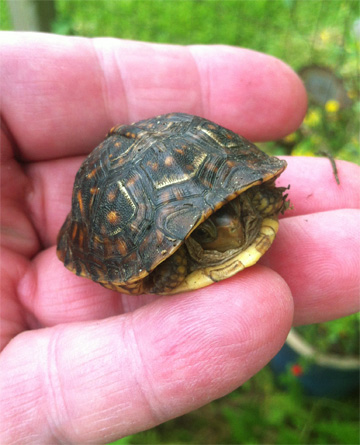
Baby Box TurtleThe turtles moved in and thrived. My mother feeding them cat food daily must have helped. They mated and laid box turtle eggs and we had new generations of turtles! (The one in the picture is a baby.)

Eventually, my folks moved out of Kenner to River Ridge. In fact, they moved no less than four more times, and my dad had to build a new turtle pond at each house. (This was their “gypsy phase.”)

Meanwhile, I grew up, went to college, married, went in the Air Force and moved back home after discharge, settling in Old Jefferson. Finally, my dad got tired of building turtle ponds and moving turtles, so I inherited them. I wasn’t asked, I was told, “Here are your turtles.”

Well, I wasn’t about to build any turtle ponds, but I did have a fenced vegetable garden area inside my fenced yard, and the turtles went in there to “free range.” And they prospered, mated and laid box turtle eggs! Our boys learned about sex watching box turtles mate.

The turtles also came in handy for Heath’s and Ryan’s birthday parties. I would collect up as many turtles I could find, paint numbers on their shells and the kids would have turtle races. Each kid picked a turtle, which we placed in a circle in the grass. The first turtle to make it out of the circle won a prize for its “owner.” The kids loved it and those we run into years later often mention our turtle races when they were young.

Disaster struck. We had a couple of really cold winters. Box turtles bury themselves for the winter and most did not survive. But a few must have, as we would sometimes encounter a young box turtle in the yard for years after.

In 1986 we moved from that house to one about four blocks away as the crow flies. Every few years I find a box turtle roaming around the yard. When I do I release it into the fenced area of our yard. Either they get out again or are really good at hiding because I very rarely find one inside the fence again. However, last summer Janis found a baby box turtle in our garden. We must have a mated pair somewhere in our yard!

I am sure the ones I am finding today are descended from that original bunch I brought back to Kenner from Waveland.

2 Comments

Filed under Family History, Growing Up, Waveland

Ethan the Christian

Ethan6B REDUCEDIt should be obvious from reading The Last Day of Forever and An Eternity of Four Years that Ethan’s faith plays an important role in his character. Sometimes he succeeds as a Christian and sometimes not. Christians are not perfect, although some critics of the faith suggest we ought to be so 100% of the time. For them, seeing a Christian fail can be a moment of triumph when they can point a finger and loudly exclaim, “Hypocrite!”

If you have ever read the Bible, one fact should strike you: It is full of “hypocrites.” Of the many characters in the Bible, only one is without flaws. All the rest in some way fail, often spectacularly. They are, after all, fallen individuals, not plaster saints, and God lays out their failures for the rest of mankind to see and learn from.

One of the most interesting examples of this is King David and the Bathsheba affair. I believe, having assumed the throne after so many years of being hunted by Saul, he became arrogant. Success can do that. I think 2 Samuel 11:1 suggests this when it says, “It happened in the spring of the year, at the time when kings go out to battle, that David sent Joab and his servants with him, and all Israel; and they destroyed the people of Ammon and besieged Rabbah.” David’s place was with the army in the field and not back in Jerusalem strolling on the roof of the palace to become involved with Bathsheba.

You would think someone like David, “a man after God’s own heart,” would have admitted his lapse in judgment immediately following his night with Bathsheba. But no, when she became pregnant, he doubled down and arranged the death of her husband in a misguided attempt to hide what he had done. Arrogance begat lust, and lust begat adultery, and adultery begat murder. Sin is like that.

It was roughly a year after the event before David finally had a “wow” moment concerning what he had done. A year later! Along came Nathan the Prophet to tell a story that backed David into a corner, and he ended up convicting himself. Only then did David finally recover from his denial and accept his own failure—and face his discipline. I have no doubt that during that year, David frequently had moments where he considered what he had done was wrong, and I have no doubt but that each time he rationalized it away somehow. To get well, you must first admit you are sick.

Christians are not perfect, and Ethan is not Jesus Christ. He loves God much like King David did, and like David, Ethan sometimes fails to measure up to God’s expectations. And like David, sometimes Ethan gets a little smug and full of himself, and it catches up with him. He refused to accept responsibility for his failures and more importantly, he refused to seek the remedy, preferring instead to seek relief in a bottle. When a Christian is out of sorts with God, he can sink so far down that there is nowhere to look but up.

I intentionally wrote Ethan’s character as “flawed” and “human.” After reading an early manuscript for The Last Day of Forever, my wife commented, “Ethan is too perfect.” My reply was, “Wait until you see him in An Eternity of Four Years.” After experiencing success out west and returning home to find Rachel waiting for him, he seemed in command of his world and his life. His smug “victory dance” before the mirror in the closing chapter of Last Day is a hint of “pride goes before the fall”—and of things to come.

One point I wanted to make in these two books is God orchestrates our circumstances. How we react to them is our choice. As Blue tells Ethan in Eternity, “Adversity makes you bitter or better, but you choose which.” And also in Eternity, Rachel summed up the underlying theme of the books when she challenged Doctor Johnson with Romans 8:28. (I’ll let you look the passage up.)

So, surprise! I am a Christian, and like Ethan and David, I admit I am not perfect. I admit I sometimes don’t seek the solution I should seek. I admit my faith is sometimes weak, and even on occasion, I choose “bitter” over “better.” In other words, I’m a work in progress that will see perfection only in eternity. If you wish to call Ethan or me a hypocrite, that is your choice, but at least do so with the understanding that none of us are claiming the status of deity.

To get well, you must first admit you are sick.

Leave a comment

Filed under An Eternity of Four Years, Catahoula Books, Civil War, Last Day of Forever

An Eternity of Four Years – UPDATE

Heads up! Better get with finishing up your read of The Last Day of Forever, because I just uploaded the files to CreateSpace for the exciting conclusion to this epic story.

Here I go making predictions again… I expect to have it published in June.

Meanwhile, here is a teaser for you from An Eternity of Four Years. This scene takes place in the spring of 1862 and the boys from Louisiana are joining Stonewall Jackson in the Shenandoah Valley for the start of Jackson’s famous Valley Campaign.

*****

Book 2 1As the sun rose on the morning of 19 May 1862, we marched out of camp. Ewell went north, and the Louisiana Brigade went west. Taylor had me ride along with him so he could question me about Jackson. Blue rode along with Taylor’s servant.

As we drew near New Market and Jackson’s camp, Taylor had his regimental commanders tighten up the formation. The men of Taylor’s Louisiana Brigade, 3,000 strong, marched down the Valley Turnpike and into Jackson’s camp that evening with regimental bands playing smart martial airs, the drums beating the cadence, and bayonets and polished gun barrels glistening in the warm glow of the setting sun. It was a sight to stir the hearts of even the most hardened.

Taylor and his staff were in the vanguard, followed by Wheat’s band playing The Girl I Left Behind, then the Tiger Rifles in their fancy zouave uniforms following close behind the band. The Virginians and Marylanders of Jackson’s command poured out of camp and lined the road on either side, hooting and cheering us on. That only served to make us prouder. The bands played louder, and we put even more snap into our step. I am here to tell you that there was no grander sight than this magnificent brigade marching proudly up the turnpike under our blue pelican battle flags. My heart fairly wanted to burst from my chest!

Jackson watched from a distance as his fresh new brigade trooped smartly by. He soon sent a member of his staff to greet us and instruct us to march through his whole army to camp on the north side. We didn’t realize it at the time, but the Tigers were being positioned in camp so we would march in the vanguard of Jackson’s army when we broke camp the next day and moved north.

We marched into the fields designated for us, and our officers shouted commands in French to the amazement of Jackson’s troops gathered around to watch the show. Our bands continued to play, and some of our boys joined in pairs and danced in gay abandon as if their partners were the most beautiful Creole belles of New Orleans. Once more the battle hardened veterans of Jackson’s Valley Army cheered.

Taylor laughed at the amazed Virginians then turned to me. “Where is he, Captain?”

I looked about for Jackson. I had seen him earlier when we marched down the pike but had lost him in the crowd. I soon spotted his lanky figure sitting on a rail fence overlooking the camp and road. “That’s him, sir, there on that fence,” I replied, pointing.

“Come along, Captain. I expect you will want to tell him hello.”

“Yes, sir.” I followed Taylor as he made his way through camp to Jackson.

Stonewall was sitting on the top rail, sucking on a lemon to ease his stomach problem as was his habit. He wore high cavalry boots that seemed oversized even for him, and his uniform was faded and weathered looking. I soon realized it was the same one he had worn back at VMI. He had a dark heavy beard, and brooding eyes peeked out from under the bill of his kepi, which he wore rakishly low over his brows so as to almost hide his eyes. He looked weary and much older than when I had last seen him.

I held back, and Taylor stepped up and introduced himself. Jackson nodded and glanced over at me for a moment. Then turning back to Taylor, he asked in a low even tone, “By what route did you march today and how many miles?”

“Keazletown Road. Six and twenty miles.”

Jackson gestured with his lemon to our brigade. “You seem to have no stragglers.”

“Never allow straggling, sir.”

Jackson nodded knowingly. “Then you must teach my people. They straggle badly.”

One of our bands struck up a tune, and the men began dancing again. Stonewall watched for a few moments then said softly, “Thoughtless fellows for serious work.”

Taylor turned and looked over his shoulder at his brigade then turned back to face Jackson. “I expect the work will not be less well done because of the gayety, sir.”

Stonewall nodded but made no reply. Turning once more to me he said, “I believe I know you?”

“Yes, sir. I was a student at VMI, class of ‘60.”

Jackson smiled. “Of course,” he replied evenly. “You’re Ethan Davis, aren’t you? The moustache deceived me. How are you, Captain Davis?”

*****

1 Comment

Filed under Catahoula Books, Civil War, Excerpts, Last Day of Forever

Gunfight at the Not-So-OK Corral

KIM RS TARGET RI sleep with a loaded, cocked-and-locked, 1911A1 .45 Auto pistol beside my bed. Some of you might question the wisdom of that, especially after reading this story. The one on the left is actually an abbreviated Officer’s Model with a 4″ barrel, my favorite carry piece. These nights, it rests on my Bible on my bedside table, but I used to keep its big brother with the 5″ barrel in a holster jammed between the mattress and side rail of my bed. All I had to do was reach over the side of the mattress and my hand naturally fell right on it.

It was after midnight one night some thirty plus years ago, when I was disturbed from a very sound sleep by my wife exclaiming, “No! No! Nooo!”

Needless to say, that got my attention. In the darkened room, bleary-eyed moi looked over at Janis beside me—AND a man in a plaid shirt is leaning over her!!!!

Ninja-like, I sprang into action. In one not-so-smooth movement, I reached for my trusty 1911 while rolling out of the bed and, very un-ninja-like, my feet became entangled in the covers. I landed with my butt on the floor, my feet still up on the bed, and I was folded in half and firmly wedged with my back against the chest of drawers beside my bed. Thus positioned, I was virtually helpless!

But I am armed!

I had my pistol in my hand, observing proper gun handling by keeping the muzzle pointed in a safe direction (Rule 2) and my finger off the trigger until I had a target (Rule 3).

Still hopelessly jammed between bed and chest, with my left hand, I frantically pawed for the big Maglite I kept on the lower shelf of my bedside table. Flashlight in hand and arm fully extended, three “D” cells of Maglite power lit up the night on Janis’ side of the bed, and I was fully expecting to ventilate the intruder.

But no one was there.

I was thinking, my ninja-like movements must have scared him off. To be certain, I passed the beam around the room and then over Janis. When the beam hit her face, she stirred, sat up and looked at her husband still solidly jammed between bed and chest. And she sees two feet sticking up, a gun held aloft in one hand, flashlight held aloft in the other waving around like a drunken lighthouse beacon, and the top of my head about down to my frantic-looking eyes, and she calmly asked, “What are you doing?”

Well now, under the circumstances, I had to give that question some serious thought. I finally replied as evenly as my excited self could, “I am not really sure…”

After I disentangle myself from my “hole” between the bed and chest, I did a house clearing drill just to be certain there were no intruders. As expected that exercise was fruitless. Evidently, Janis had been dreaming and said what I heard, and I am sure I heard it, because it woke me up. I must have “joined in her dream” and “saw” the plaid-shirted man leaning over her and reacted accordingly.

Good thing he wasn’t there, because I would have ventilated him!

1 Comment

Filed under Family History, Firearms, Growing Up

The Perfect Sazerac Cocktail

SazeracCocktailThis is a continuation of my recent post A Short History of the Sazerac Cocktail.

The Sazeracs Ethan drank in The Last Day of Forever and An Eternity of Four Years were not as sophisticated as the modern versions. Sazeracs in the 1850s and 1860s were probably only Sazerac Cognac, a couple dashes of Peychaud’s Bitters and some sugar. While ice was available then, the drink was more likely served at room temperature.

The modern Sazerac is not an easy drink to make and requires a bit of ritual. While a well-made Sazerac is a delightful drink, a poorly made Sazerac is truly awful. Many bars and restaurants in New Orleans make good Sazeracs, and some not so good. A safe bet to have one is at the Sazerac Bar in the Roosevelt Hotel. You can use theirs to gauge what a good Sazerac should taste like. Or, make one according to my recipe.

The original (modern) Sazerac consists of five simple ingredients: Sazerac Rye Whiskey (I use Sazerac Rye 6YO), simple syrup, Peychaud’s Bitters, a sliver of lemon peel (the yellow part, not the pulpy white part or the juice), and good quality ice. You will also need two heavy-bottomed, Old Fashioned glasses, a teaspoon to measure and stir with, a two-ounce jigger, and a cocktail strainer of some sort. There are variations on this ingredient list; some use Angostura Bitters along with the Peychaud’s. While that is a common practice these days, that is not the original (modern) recipe.

You must prepare ahead. One of the two glasses needs to go into the freezer for at least 30 minutes to chill down. In a pinch, you can pack it with ice and let it chill that way, but the freezer method is much preferred. You must also prepare the simple syrup far enough ahead so it can come to room temperature or even be chilled. I make small batches and store mine in a jar in the refrigerator. They say it keeps for up to a week, but I have kept it a bit longer.

Lane’s Sazerac Cocktail Recipe Secret #1: Most make simple syrup using white refined sugar, but I have recently experimented with Organic Turbinado Raw Sugar, which is partially refined sugar. It retains some of the natural molasses flavor of raw sugar. That little hint of molasses adds a wonderful subtle bouquet and flavor to the Sazerac. I make all my Sazeracs with Turbinado Raw Sugar simple syrup these days.

Simple syrup is easy to make, but you must be careful or you will have a sticky mess to clean up. I make mine in the jar I am going to store it in, and I suggest you use a cooking container that you will not fill to more than one fourth. (Why in a moment.) Mix one part Turbinado Raw Sugar (or white sugar) with one part bottled or filtered water by volume. I usually make only a two-tablespoon batch (two tablespoons sugar and two tablespoons of water). Using only a teaspoon of simple syrup in each Sazerac, this is more than enough for my relatively infrequent needs. Mix it as best you can, but much of the sugar will not dissolve. Next, the mix goes into the microwave or on the stove. I use the microwave because it is faster.

VERY IMPORTANT: You must not leave the cooking simple syrup unattended. Once it starts boiling, it is like a volcano erupting, only much faster. You must stop the cooking before it erupts all over the inside of your microwave! This is why I suggest the total contents not exceed one fourth of the cooking container.

Cooking time will depend on how much is being made. Stop the cooking as soon as it begins boiling. Take it out and stir it to dissolve the sugar. One trip through the microwave will probably not be enough to dissolve all the sugar. Stick it back in and bring it to a boil again. It will boil sooner this time. Take it out and stir. Make sure all the sugar is completely dissolved. Twice usually does it for me, but if a third trip into the microwave is needed, then do it. You can, of course, make simple syrup the old fashioned way in a pot on the stove. Bring it to a very low boil and stir as it cooks. Once all the sugar dissolves, take it off the heat to cool.

If made with Turbinado Raw sugar, the resulting simple syrup will have the color of motor oil. That is because of the molasses content of the sugar. This has to cool before you use it. Once it reaches room temperature, I cap it and stick it into the refrigerator to be used when needed. It will hold for at least a week.

The third ingredient that needs pre-prep is the lemon peel and use good fresh lemons. As mentioned, you want only the yellow part of the peeling and none of the white pulpy part. You are after only the oils in that yellow peel. Use a sharp knife and carefully shave off a strip about a quarter to a half-inch wide and an inch to two inches long. You can experiment with size. I prefer a larger peel.

Lane’s Sazerac Cocktail Recipe Secret #2: Recently, I started experimenting with orange peel instead of lemon peel, and I like the very subtle flavor the orange peel adds. Lemon peel is traditional, but try both and see which you prefer. Whether lemon or orange, you need good quality fruit to harvest the peel from.

Gather your ingredients and get ready to build a fabulous Sazerac. Everything should be at hand and ready to grab except the frozen glass, which I leave in the freezer until the last possible moment.

Step 1 – In the unfrozen Old Fashioned glass, add one teaspoon of your simple syrup, three dashes of Peychaud’s Bitters, and two ounces of Sazerac Rye Whiskey. I use Sazerac Rye 6YO (SPAR did the package), but their Antique Collection Sazerac Rye 18YO, the winner of American Whiskey of the Year (SPAR did this package, too), makes a Sazerac to die for. However, you may have to arrange bank financing to buy a bottle of the 18YO, assuming you can even find it. It is usually released in October and gone before the end of the month. If you want a bottle, make friends with your local liquor store owner. (You might want to consider bribing them.) And expect to pay above MSRP. It is that good and that popular.

Next, fill the Old Fashioned glass containing the ingredients to the top with a good quality clear ice and stir (not shake) vigorously until the ice is partially melted. This usually takes about ten seconds. I stop when I see the ice has melted enough the cocktail is nearly covering it. Obviously, more melt means a weaker drink. Experiment and find your perfect melt level.

Step 2 – Now, you must move fast! Retrieve the frozen glass from the freezer (or dump the ice from it if you chilled it that way). I usually have my wife hovering near the freezer awaiting my call for the glass. Best to do the following over a sink, because you might spill some of the Herbsaint. Put about a tablespoon or less of Herbsaint into the frozen glass. Rotate the glass so the Herbsaint coats all around the inside of the glass as far up to the rim as you can get it. (This is where you are likely to spill some.) Work fast; you want that glass to stay cold! Dump any remaining Herbsaint out. You want only a hint of the Herbsaint remaining in the glass. Too much will ruin the drink.

Step 3 – Using the cocktail strainer, strain the mixed cocktail into the frozen Herbsaint–coated glass. Some drink it “on the rocks.” That is not the original, but if that is “your perfect Sazerac,” go for it.

Step 4 – Wipe the rim of the glass with the lemon (or orange) peel then twist the peel over the drink to squeeze out some of the oils. I toss it in for good measure, but that is not the original. Some say never toss it in but hook it over the rim of the glass as a garnish giving off a citrus aroma as you sip the drink.

Step 5 – After all that work, you must be tired? Head for your favorite recliner and rest from your efforts while you enjoy your perfect Sazerac Cocktail.

I think I hear a Sazerac calling me now?

The Sazerac Cocktail name is a trademark of the Sazerac Company of New Orleans.

1 Comment

Filed under An Eternity of Four Years, Catahoula Books, Cocktails, Last Day of Forever

A Short History of the Sazerac Cocktail

Both The Last Day of Forever and An Eternity of Four Years mention a drink called the “Sazerac” but give only minimal information about how it is made. I am going to boast that I make the finest Sazerac in the world, maybe even the Universe.

But first, in the interest of full disclosure: The Sazerac Company of New Orleans is one of my clients at Spar, Inc. In fact, the man who owns the Sazerac Company and the five distilleries that Sazerac owns, starting with the Buffalo Trace Distillery in Frankfort, KY, plus two others in Kentucky, another in Virginia, and one in Canada, also owns SPAR, Inc. I have worked for SPAR since I got out of the Air Force in 1973. Started as a graphic designer, and now I am the general manager and creative director. SPAR designed most of the packages for the Sazerac Company, such as Buffalo Trace Bourbon, Sazerac Rye Whisky, Herbsaint, W.L. Weller, Old Charter, Elmer T. Lee, Nikolai Vodka, and a ton more. You get the picture?

So, I have a financial interest in the Sazerac Company, so to speak. They generate my paycheck. But that isn’t why I mentioned the drink in my story. I mention it because the Sazerac Cocktail is such an integral and beautiful part of New Orleans history. It was created here, and its ancestry goes all the way back to the eighteenth century when Antoine Amedee Peychaud, a refugee from the slave uprising in Haiti, landed in New Orleans in about 1795 with his family recipe for bitters and eventually set up shop as an apothecary.

CoquetierAs the story goes, Peychaud served shots of brandy laced with his bitters in a little double-ended eggcup called in the French a cocquetier. Legend has it the term “cocktail” comes from the Americans arriving in New Orleans after the Louisiana Purchase, tripping over the unfamiliar French word, and anglicizing it. To be fair, that is under dispute. Some claim the term “cocktail,” describing a mixture of whiskey, bitters, and sugar, came into usage around 1800 before Peychaud started serving his coquetiers, but I am sticking to the New Orleans version.

The Sazerac name came from the brandy that was originally used to make the drink. That would be Sazerac Cognac Brandy imported from Sazerac des Forges et Fils in France. That Sazerac Company did exist until fairly recently. Evidently, they have folded, because I cannot find them on the internet anymore. (UPDATE: Sazerac New Orleans bought the French company and is making the original Sazerac Brandy again. They also opened the “Sazerac House” on Canal Street in New Orleans, a museum showcasing the history of drinking in New Orleans. Free but reservations required.)

People in New Orleans always seem to do things just a little differently. For example, we had lots of coffee houses back in the nineteenth century, only they weren’t really coffee houses. Oh, they served some coffee, usually laced with brandy or rum and later American bourbon, but they were, in reality, saloons. By 1859 there were 204 saloons coffee houses in New Orleans. In the early nineteenth century, New Orleans entered its coffee house gem period, with owners naming their saloons coffee houses after various precious stones. Each new saloon coffee house tried to top the other by selecting a more valuable gemstone for its name. One named the “Gem” opened in 1851. The Gem featured the Sazerac, as did most other saloons coffee houses in New Orleans, but this one became famous. It was located in the first block of Royal Street with another entrance on Exchange Alley. Its name was eventually changed to the Sazerac Coffee House. This is where Ethan with Morgan and later his friends, when he enlisted in Wheat’s Battalion, shared many Sazeracs. Don’t bother to look for it, because it isn’t there anymore. The Sazerac Bar eventually moved into the Roosevelt Hotel and remains there to this day. The Sazerac Bar is not owned by the Sazerac Company.

Originally, the Sazerac was made with Sazerac brandy and Peychaud’s Bitters, but American rye whiskey began replacing the brandy around 1870 because of the phylloxera epidemic in Europe that devastated the vineyards of France, making brandy scarce (brandy is made from grapes). Kentucky had been settled by many of Scottish origin and they were converting their corn crops into whiskey, because it was easier to move whiskey to market than corn. Packed in barrels, Kentucky whiskey made its long trip in flatboats down the Mississippi to New Orleans. Storing the whiskey in barrels and the long trip actually aided its flavor, and the product that arrived in New Orleans was less like the raw fiery spirit that left Kentucky. About the same time, a bit of absinthe was added to the recipe of the Sazerac, and the recipe was sealed until the 1930s when Herbsaint, a New Orleans product, came into common usage in the Sazerac.

Herbsaint Absinthe was produced using a recipe ­­­­New Orleans native Marion Legendre brought back from his service in France during World War I. Legendre began producing his Herbsaint during the mid-thirties and ran afoul of government regs that had banned absinthe back in 1912. He was forced to change his recipe to suit the government bureaucrats. Only recently has absinthe reappeared in America again, and that is only because it was discovered the law banning absinthe was written in a way that actually allowed its production as long as the amount of wormwood, a botanical, was below a specified amount, and absinthe’s wormwood content is well below that point. With that, the Sazerac Company, owners of the Herbsaint brand, dug into their archives and came up with Legendre’s original formula. The Original Herbsaint is back (and SPAR did the retro package).

The Sazerac Cocktail, now enjoying something of a revival, is served in bars and restaurants all over New Orleans and many other cites, as well. But I must warn you. Not everyone makes a good Sazerac, and a poorly made Sazerac is truly awful, usually because they put in too much absinthe. But I am going to tell you how to make a good one, in fact, a perfect Sazerac Cocktail. You will have to wait for the next post to get my “secret” recipe.

Wikipedia absinthe page.

Absinthe deserves its own post. It is featured in the opening chapter of An Eternity of Four Years, and will get that post eventually.

Coquetier photo credit: Coyau / Wikimedia Commons / CC-BY-SA-3.0

3 Comments

Filed under An Eternity of Four Years, Catahoula Books, History Lessons, Last Day of Forever

AT LAST! It is published!

Cover B1Well, almost. The digital version of The Last Day of Forever will be released for sale on Friday May 8! It is available as a preorder NOW. To order it now for delivery May 8 (digital versions) go here.

BUT, the paperbacks are available for purchase NOW. To get your copy go here.

This is what will be available:

Digital versions of The Last Day of Forever – Right now, it is only available on Amazon for Kindle devices. You can download free Kindle reader apps for other devices like iPads. There is a link for that at the Amazon page for The Last Day of Forever.

Print version of The Last Day of Forever – The link will take you to CreateSpace, a division of Amazon. (Eventually, it will be listed on the Amazon page also.) These books will be PoD (Print on Demand), meaning they will be digitally printed as they are ordered. They will be 6×9 paperbacks, but the quality is very high. Sorry, but I will not have any to sell direct, because I will not be applying for a retail sales tax license from the parish and state. If you simply must have it signed, I will be glad to do so. Contact me, and we will work something out.

Here is what you need to do:

  1. Buy a copy now.
  2. Read it and enjoy it.
  3. Go back to where you bought it and post an honest review.
  4. Tell all your friends.

What is next?

Assuming you like The Last Day of Forever, you will probably want to read An Eternity of Four Years, which continues the story. While The Last Day of Forever is mostly a coming of age love story, An Eternity of Four Years is much darker since it takes place during the Civil War, and both Ethan and Rachel are, of course, involved in it. The Last Day of Forever will probably appeal more to women; An Eternity of Four Years will probably appeal more to men. Not sure that was a good idea or not, but it is where the story went. I expect to release An Eternity of Four Years very soon.

Will there be a Book 3? Working on it. Working title is The Avenging Angel, but it has a long way to go. There may also be other stories in the Catahoula Series based on spin-off characters, like Silas Riddle, whom you will meet in An Eternity of Four Years.

Lastly, I want to thank you, my friends and relations, who have been supportive of me and patient during this process, especially my bride. I truly enjoyed telling this story, and I hope you will enjoy reading it. By all means, email me with your comments and suggestions. The nice thing about digital publishing is if something is broken, it can be fixed. I can simply correct the digital file and upload the new one. I did my best to rid the files of issues and had several beta readers review the story and edit it, but I am sure something slipped past all the eyes that were on it.

As my teachers in school used to say, “Put down your pencils and turn in your papers.” Pencils are down and the papers are turned in—warts and all.

Thank you! Enjoy!

Leave a comment

Filed under An Eternity of Four Years, Catahoula Books, Civil War, Last Day of Forever

“I hate that rabbit!”

I was about 18 when the incident I am about to tell about took place. We had a black rabbit, and his name was Messa Brother. (Don’t ask me to explain that.) I think I may have been the one responsible for introducing him to the household one Easter? It seemed like a good idea at the time, but like many of my “good ideas,” it was really a bad idea. (I should have learned my lesson with the chickens.)

Messa Brother soon grew from a cute little Easter bunny into a full-grown pain in the rear. He had free-range of the house, and I mean anywhere in the house. Even though my mother housetrained him (sort of) to use a litter box like the cats, he sometimes got lazy, and if he was at the far end of the house from the litter box when the urge hit, he simply left his “buckshot” wherever it suited him. And the “far end of the house from the litter box” was my bedroom.

Like all rabbits, he had a need to chew stuff, and what he chewed didn’t matter all that much to him—most of the time, that is. He seemed to have a strong preference for my dad’s shoes. It took the loss of a few pair of shoes before MB made sure his closet was always closed to keep Messa Brother out. After that, he shifted his chewing needs to the electrical wires for the various appliances, like lamps, alarm clocks, radios, and TVs.

One day while I was watching TV, Messa Brother hopped into the room and went behind the big console TV standing in a corner. I paid him no mind as long as he was leaving my shoes alone. Suddenly, the lights dimmed, the TV went dark, and Messa Brother rolled from behind it and ricocheted off the wall like he had been shot out of a cannon. When he came to rest, he was lying on his back with his black fur looking real frizzy and a wisp or two of smoke rising from it.

Messa Brother had discovered electricity—again!

How it didn’t kill him, I am not sure. He laid there for a while looking kind of dazed, then eventually rolled over, shook a little, and hopped off to find some shoes. They didn’t bite back.

Well, maybe they did bite back, in a manner of speaking.

It was a Saturday afternoon, and I came in to find my dad sitting at the kitchen table drinking his Regal beer. Like most people in New Orleans, everyone consumed alcohol in some form. MB’s favorite was beer. I can remember seeing him what I would consider as a bit snockered only one time, and that Saturday was the time.

I took a seat at the table to talk to him. I believe my mother and two sisters were in Waveland at the time, so we were the only two in the house. I asked what was troubling him.

He just sat there and kind of nodded before taking a pull on his Regal. “I hate that rabbit!”

He wasn’t going to get any arguments from me on that point, since Messa Brother had taken to chewing my shoes now that my dad’s was safely behind a closet door, and wiring seemed to bite back. My Weejuns didn’t look very cool with the back chewed out!

He continued in a low monotone voice, “Lane, I gave that rabbit enough morphine to kill a horse.” (Being a doctor he had access to morphine.)

Somehow, I knew there was a “but” coming, because Messa Brother was still very much alive and apparently enjoying good health. “What happened?”

He shook his head and eventually continued after another long pull on his Regal. “He just slept for three days! He should be dead, but he slept for three days! I hate that rabbit!”

Messa Brother lived less than a year after that. He suddenly died while on a family trip to our house in Waveland one summer evening. Heat prostration was my dad’s diagnosis. Those cars we had back then without air conditioning could be very, very dangerous! (Snort!)

But I always suspected it was a two-horse dose of morphine that did Messa Brother in.

2 Comments

Filed under Family History, Growing Up, Kenner