Monthly Archives: July 2015

Today, I lost my best friend …

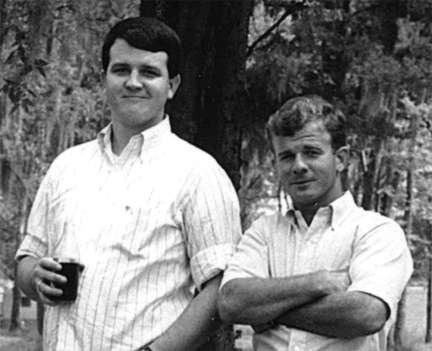
Lane & Buck ca 1963Michael (Buck) Roy and I have been friends for nearly 60 years now. During that time, we were like the closest of brothers. In fact, he lived with my family for a spell when we were teenagers. He went to be with the Lord this morning around 9am.

In a way, I am glad he’s gone, because he suffered with Lewy Body Dementia. He was aware he was quite literally losing his mind, and as expected, it scared him, and not many things scared Buck. It would scare me, too. I know he would not want to live in his own private hell of non-existence, dealing with the frightful hallucinations he was having as a result of the LBD.

He’s at peace now.

It is hard to put into words one’s feelings for another after being so close for so long. We shared so many adventures together, some of which I have written about here and here and here. (And I will write more as they come to mind.) We spent many a night around a campfire, discussing things that made no sense to us and things that did, solving the world’s problems and maybe helping aggravate a few. Our minds worked so much alike, it was scary. I suppose that is what drew us to each other.

Buck, which is what all of us who knew him from childhood called him, was one of the most outgoing people I ever knew. He could strike up a conversation with anyone about anything, even if he knew nothing of the subject. It was very hard to not like Buck. It was very hard not to smile when around him for any but the briefest periods. We did smile a lot, and we did laugh a lot, and we even wept on each other’s shoulders when we were hurting inside.

We knew the other would be there when we needed help, have each other’s back in a fight, even down to burying the body if it ever came to that.

Buck is gone now, but will never be forgotten. The best part of his passing is I know I will see him again in eternity. You see, when he was a teenager, Buck accepted Christ as his Savior. He went forward at a Billy Graham Crusade in New Orleans. Our separation will, therefore, be only temporary. And once again we can sit around a campfire, this time in Heaven, and swap tales.

In the meantime, I am going to really miss him.

11 Comments

Filed under Family History, Growing Up, Kenner

Backing up! Beep—Beep—Beep!

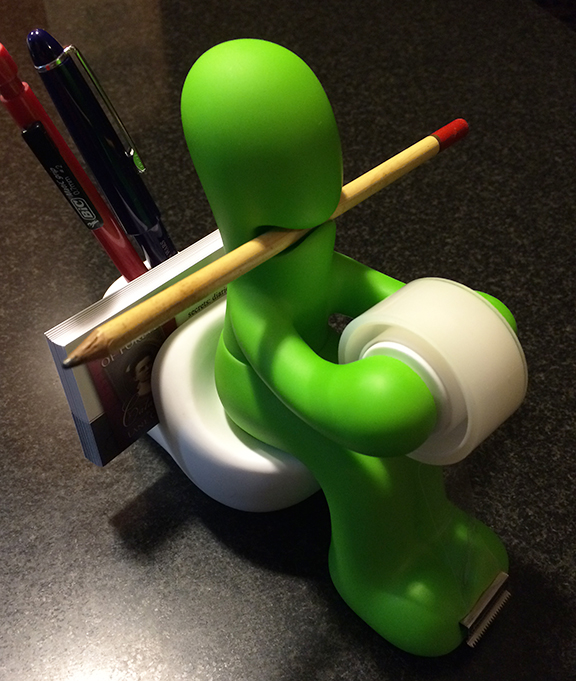
Toilet Desk SetAt my birthday party last night, we got to swapping some old stories. Some I will be sharing and some—well, maybe not. Here is one I was reminded of by a birthday gift. (That “desk accessory” on the left. I seem to have something of a reputation relating to toilets?)

With the onset of age comes what seems like a smaller bladder and, with that, perhaps a few trips to the bathroom at night.

Now, this is a challenge: You don’t want to wake up any more than absolutely necessary, otherwise going back to sleep gets iffy.

So, I make the trip in the dark and turn on no lights, guided only by moonlight or streetlight coming through the windows, lest I wake up more than necessary while getting the “job” done. Since there is not significant light for aiming purposes, and standing also tends to require more wakefulness—(getting my drift here?)—I sit. (OK, like a girl. Happy now?)

On this occasion, I’m sitting in the dark with my elbows on my knees, my head resting in my hands, and maybe even dozing a little during the eliminating process, trying desperately to maintain just enough wakefulness to avoid falling off the toilet but not wake up any more than absolutely necessary when …

I get the feeling I’m not alone.

I open my eyes and, in the weak light coming through the window, what fills my vision but Janis’ buttocks! She has the skirt of her nightgown hiked up and is backing up to the toilet—the one I’m occupying!

So, I calmly say, “Only one of us can fit on this thing, and I was here first.”

That was followed by a loud screech and a quick withdrawal of said buttocks.

Now, I’m wide awake from laughing.

Backing up! Beep—Beep—Beep!

3 Comments

Filed under Family History

The Brains of the Confederacy

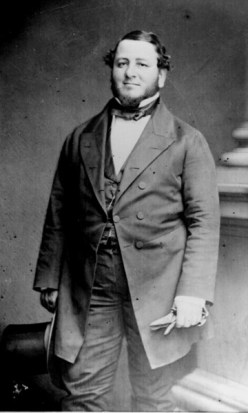
Judah_BenjaminIn both of my books, The Last Day of Forever and, especially, An Eternity of Four Years, a gentleman by the name of Judah P. Benjamin plays a part. Judah P. Benjamin remains something of an enigma because he destroyed his private papers at the end of the Civil War, and in spite of leading a very public life as a successful attorney, planter, politician, and statesman, some aspects of his personal history remain cloaked in a mystery and speculation.

He was a most unusual man for his times and by all accounts very intelligent, a skilled debater with a gift for oratory and a ready smile.

It is said the ladies of Richmond adored him, but he had his detractors as well as those who admired him for his considerable intellect and outgoing personality. Jefferson Davis considered him one of his closest confidants with the writings of Davis’s wife, Varina, offering a small peek into his personal life.

Judah Phillip Benjamin was variously know as “the Jew,” “the Hebrew,” or “Davis’ pet Jew,” referring to his small stature (barely over five feet tall). Later historians sometimes refer to him as the “brains of the Confederacy.” During the war, the North derisively called him “the South’s evil genius.”

He was born to a family of Sephardic Jews in St Croix in 1811. When he was still a child, his family eventually settled in Charleston, SC, a southern city known for its religious tolerance. He attended Yale at the tender age of 14 but was expelled because of unspecified “ungentlemanly conduct.”

Benjamin then headed for New Orleans, where according to Bernard W. Korn in his volume on that city’s Jews, he arrived “with no visible assets other than the wit, charm, omnivorous mind and boundless energy with which he would find his place in the sun.” He remained a bachelor for several years, and at least one historian suggests he was a homosexual, but there exists no evidence beyond speculation to support this.

He clerked in a law firm and studied the law. Since fluent French was required to practice law in Louisiana, he needed to learn that language. To earn money, he tutored French Creoles in English and taught Natalie Bauché de St. Martin in exchange for her teaching him French.

In 1832 at the age of 21, he was admitted to the bar, and a year later, he married Natalie with the wedding in St Louis Cathedral. The couple moved into a four-story townhouse on Bourbon Street that is today a strip joint called “Temptations.” It seems the marriage did not work out for reasons unknown. Historians suggest Natalie was such a problem child her family was glad to be shed of her, and later, rumors of infidelity were associated with her. They had one child, a daughter, Ninette.

Benjamin became a successful lawyer in New Orleans and bought a plantation downriver from the city, Belle Chasse*, and built a fine home for his wife and daughter. Natalie, evidently, was unimpressed and decamped with her daughter for Paris where they remained for the rest of her life. Meanwhile, Benjamin experimented with different strains of sugar cane and became something of an expert on that crop.

The Louisiana Legislature elected Benjamin to the U.S. Senate where he became famous for his eloquent and fiery oratory. (Senators were appointed by the Legislature then.) Benjamin was the first Jew to serve as a U. S. Senator. He was twice offered to be nominated to the U.S. Supreme Court and declined both times. He would likely have been approved and would have been the first Jew on the U.S. Supreme Court.

With Louisiana’s secession in 1861, Benjamin became one of Jeff Davis’ closest advisors even though Benjamin had once challenged him to a duel. Davis first appointed him as Attorney General and then Secretary of War, but the Confederate Army existed mainly as untrained volunteers with supplies for waging war very scarce. With the Confederate retreat from Cape Hatteras, Benjamin was accused of failing to reinforce the garrison. He took the blame and resigned, but he did so to hide the fact that the Confederacy simply did not have the forces to send, and that weakness needed to be hidden from the enemy.

Davis then appointed Benjamin to Secretary of State where he was also in charge of the Confederate Secret Service and Confederate spies up north. It was in that capacity that my character, Ethan, has dealings with him in An Eternity of Four Years.

Very early in the war, he was one of the first to argue for recruiting the slaves into the Confederate Army, offering them freedom if they served. Near the end, when the situation was desperate for the South, he brought it up again in a speech and was renounced for it. He also suggested freeing the slaves to get France and/or England to enter the conflict on the side of the South, or at least recognize the South as a sovereign nation, opening the door to much needed war material from Europe. Again his ideas were rejected.

The war ended with the Confederate government on the run. Davis was captured, but Benjamin was not, only because he separated from the group the day before and made his way to England. There he became a successful barrister and was created a “Palatine silk” as the Queen’s Council.

With his health deteriorating and suffering from diabetes, he was injured in a fall in 1880. Judah P. Benjamin died of a heart attack in Paris in 1882 and was buried there in Père Lachaise Cemetery under the name of “Philippe Benjamin.”

In 1938 the Paris chapter of the Daughters of the Confederacy erected a plaque over his grave.

JUDAH PHILIP BENJAMIN
BORN ST. THOMAS WEST INDIES AUGUST 6,1811
DIED IN PARIS MAY 6,1884
UNITED STATES SENATOR FROM LOUISIANA
ATTORNEY GENERAL, SECRETARY OF WAR AND
SECRETARY OF STATE OF THE CONFEDERATE STATES
OF AMERICA, QUEENS COUNSEL, LONDON

Whatever your opinion of Judah P. Benjamin might be, one must agree he was a most amazing person and largely an unknown but significant figure in American history.

*Note: This link will take you to an image of Belle Chasse Plantation. It has long since been torn down. You can adjust the size of the image with the sliding bar at the top.

1 Comment

Filed under An Eternity of Four Years, Catahoula Books, Civil War, History Lessons, Last Day of Forever

The LSU Tiger Mascot Must GO!

If you have been following the craziness that has come out of that killing in South Carolina, you know there have been serious (seriously?) calls to erase history and anything associated with the South and the American Civil War, or as I prefer, The War of Northern Aggression. The mayor of New Orleans, instead of focusing on the problems of New Orleans, and they are legion, sees a need to focus on symbols, a fairly normal ploy for his party.

LSU TigerI linked to a blog post by Sally Asher here that sarcastically points out where this craziness can go, and don’t think it won’t go there, because some of what she jokes about is actually being suggested. But if this line is pursued, it has a disturbing possibility: that is we must choose a new LSU mascot! You see, there is a problem with the “Tiger” moniker—it is racist! At least under the new political-correctness-we-must-not-offend-anyone rules.

How so?

Obviously, you have not read my second book, An Eternity of Four Years, and you need to do that post-haste. If you had, you would know that Ethan joins the Confederate Army with a battalion of volunteers from Louisiana called Wheat’s Battalion, named after Chatham Roberdeau Wheat, its commander. One company in Wheat’s Battalion was called — wait for it — the Tiger Rifles!

“Big deal!” you say. But wait. There is more.

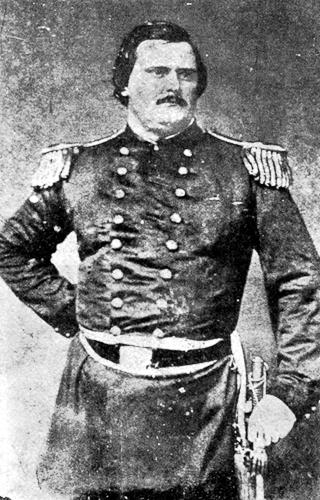
ChwheatSometime around the Battle of First Manassas when Wheat’s Battalion of rogues from Louisiana, though grossly outnumbered, distinguished themselves by holding off a Northern flanking movement until a defense could be pulled together, thus helping save the Army of Northern Virginia from almost certain defeat, Wheat’s Battalion became known as Wheat’s Tigers. (Try reading that one in one breath!)

There is still more…

Eventually, all Louisiana volunteers in the ANV became known as the Louisiana Tigers.

And guess where LSU got its mascot? Whoops!

Obviously, political correctness demands that be changed, lest it offend someone! How about the Pussy Cats?  Nah, some people don’t like cats. The Puppy Dogs? Nah, some people don’t like dogs. (There is no accounting for taste.)

I know! The “Nothings!” The only thing that won’t offend someone is nothing.

There—problem solved. The LSU Nothings. Has a nice ring to it, don’t ya think?

God help us!

(My younger son, an LSU grad, is probably angry with me now for letting this cat, a tiger as it were, out of the bag.)

2 Comments

Filed under Current Events

Let’s Rename New Orleans!

I have been thinking of doing another post on the slippery-slope we are on as a result of the actions of that demented kid in South Carolina, but now I don’t have to. Someone else did it for me.

So, I give you a post on Sally Asher’s Blog titled Let’s Rename New Orleans. She has done a marvelous job of showing how utterly insane some of us have become and where that insanity will ultimately lead to, because once you start down this road, it has no end!

I have a suggestion for you, Mitch: Instead of focusing on symbols, how about focusing on the real problems in New Orleans. Resigning would be a good first step.

God help us!

1 Comment

Filed under Current Events

Barefootin’ – Manard, Joey and Me

I took out the garbage last night, and being too lazy to look for my shoes, I dragged that can out to the curb barefoot.

And my feet hurt!

The driveway is well worn, and the aggregate tends to be a bit more exposed than in recently laid concrete. I felt like I was walking on rocks!

And you are thinking, What is your point?

I don’t really have one, other than my feet never used to hurt like that. I guess that comes with age? I remember when I was a kid, we never wore shoes in the summer, except when we had to “dress up” to go somewhere. Otherwise, once school let out, our shoes went into the closet and didn’t come out again until school started, assuming they still fit.

Our feet may have been a bit tender after nine months being encased in leather, but they soon toughened. Within a couple of weeks or so, we could run across Sixth Street, which was “paved” with gravel or clamshells, without feeling any pain. Naturally, being shoeless, we did incur a few cuts and bruises along with a few rusty nail punctures, but my dad always had the tetanus shot handy.

Those days are gone. Now I am old and a tenderfoot for life. I doubt I could stand the pain long enough to build up the calluses again.

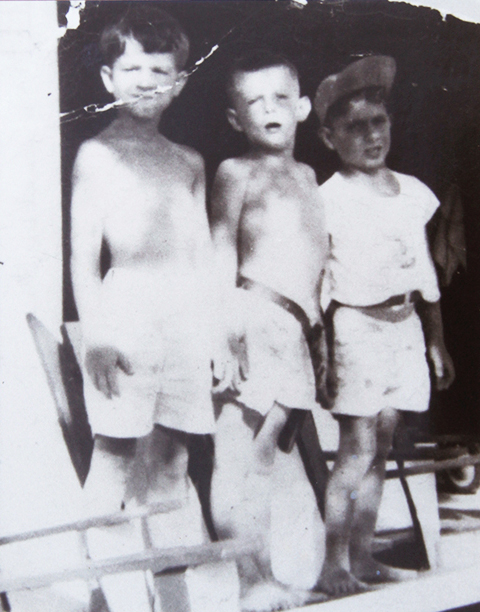
Me, Manard, Joey 1953Actually, that event reminded me of this picture hanging in my office. It is of me on the left, Manard Lagasse in the center and Joey Giammalva on the right. It was taken in 1953. We were best buddies then. I was 9 years old. Manard and Joey were 7 years old.

Note the “summer uniform,” which was limited to shorts and maybe a tee or hat but no shoes. (Side note: Joey had flat feet, and on wet concrete, he could make realistic-sounding flatulence noises with them.)

Joey’s mom took the pic, and Joey carried it in his wallet for years before he made enlargements for Manard and me.

Both Manard and Joey are deceased now. Good times together! Good memories! Good friends sorely missed! Whenever I see Bubba, Manard’s son who I think looks just like him, I want to grab him and hug him, pretending for just a few moments that “Man” is still with us.

5 Comments

Filed under Family History, Growing Up, Kenner

The Paperback Version of An Eternity of Four Years is now available!

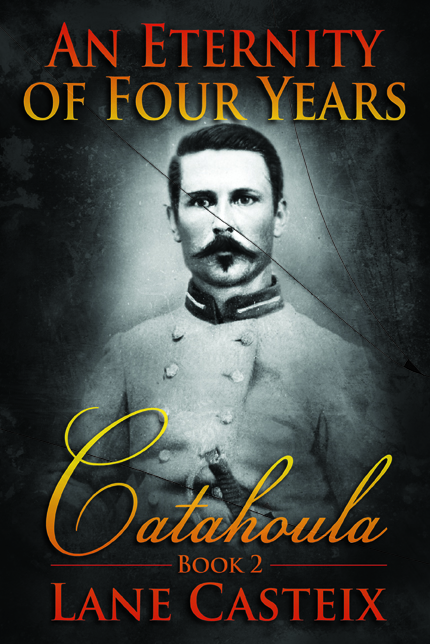
Book 2 1Finally! It is done! I have been teasing you long enough.

The exciting conclusion to the two-part epic of the Legend of Rachel and Ethan, An Eternity of Four Years, is finally finished and published. Both the Kindle digital version and the paperback version are available at Amazon.

An Eternity of Four Years picks up the story four days after The Last Day of Forever ends and carries the reader through the turbulent years of the Civil War with Ethan searching for Rachel to mend what was broken between them.

If you haven’t read part 1 yet, The Last Day of Forever, you need to read it first. Either book can stand alone, but reading both in order fills in a lot of back story and detail you will find both interesting and helpful to your reading experience.

Get ’em while they are hot! And don’t forget to go back and post a review. It will help the books get visibility and credibility.

1 Comment

Filed under An Eternity of Four Years, Catahoula Books, Civil War, Last Day of Forever

The Whitworth Gauntlet

I began a discussion here about the Whitworth Rifle used as a sniping arm by both sides in the American Civil War. I promised an excerpt from An Eternity of Four Years that featured Ethan “interacting” with that rifle. Here it is. The scene takes place during the second day of the Battle of Gettysburg in July 1863.

*****

Book 2 1I left Pepper in the care of Blue at the Johnson home and made my way down South Stratton Street to find Hays. Aware of the threat of the sharpshooters, as I got closer to Winebrenner’s Run, I moved more cautiously from cover to cover to present as small a target as possible for them to take any interest in. At the end of South Stratton, I asked some Rebs taking potshots at Cemetery Hill from an abandoned building where I could find General Hays.

“He is in Winebrenner’s Run, sir. You ain’t planning on going down there are ya?”

“Yep.”

“You sure you need to do that, Captain? They’ll be takin’ shots at ya with them Whitworth rifles with the telescopic sights all the way down to the run. You’ll be a big fat target from here on.” He gestured towards the back corner of the building, and I saw a dead Confederate slumped against the wall with the top of his head shot away. “Ask him; he’ll tell you. He stuck his head out to just have a little peek, and splat! Them Whitworths are deadly. You’ll know when you have been shot at by one, ‘cause the bullet makes a shrill whistling sound on account of its hexagon rifling.”

That was sobering.

I nodded, and he shook his head. “It’s your funeral.”

I took several deep breaths to steel myself to run the “Whitworth gauntlet.” No use waiting any longer, I thought and pushed off. I had at least sixty paces of open ground exposed to observation from Cemetery Hill before I had any more cover, a small shed sitting forlornly out in the open. I was not even halfway there, when a ball kicked up dirt not two paces past me. Before I was to the little shed, a shot went past near my head, making the shrill whistling sound just described to me. Any slower, and I would have been hit. I reached the shed just as another round chipped wood splinters from its edge.

Some of the boys down in the run saw me coming under fire and began to cheer. I sank down behind the shed to catch my breath. For good measure, one of the Yanks put a round through the flimsy little building to remind me of the difference between cover and concealment. The ball whistled through the wooden structure right over my head. Had I been standing instead of crouching down as I was, I would be dead.

I peeked around the building to see my next objective, and they put a ball into the edge of my little shed just as I withdrew my head. I was most impressed with both their rifles and their shooting skills. I did see enough to know this next leg was going to be a long one. There was a sizable oak tree about ninety paces away. I took two deep breaths and then stuck my head around the left side of the shed to draw their attention but quickly withdrew it and ran around the other side and headed for my oak tree.

The ruse worked. They put three balls into the edge of the building where I had stuck my head out, but they were not prepared for me to show myself at the other side. I ran like I was headed for the Baltimore Pike then cut back in the other direction. They fired two more shots at me just as I changed directions. I made it to the tree as another ball chipped bark off its side. The stout oak was more than concealment; it was cover. The cheering from Winebrenner’s Run grew louder as others joined in, but I was getting tired.

One last dash left to go. This one was only about forty paces and then the relative safety of the run’s high sides. Even though I was getting winded, I could not afford to wait and allow the Yankee sharpshooters time to reload, so I took one quick breath and broke from behind my tree and headed for the run. I ran left then zigzagged right, then left again with balls hitting all around me. As I neared Winebrenner’s Run and leaped into the air to clear some brush on its bank, I felt a ball tear through my shell jacket. I landed in a heap against the far side of the run and pulled myself up against its protection as close as I could get. Cheers went up and down the line. I even heard a cheer from the Yankees on Cemetery Hill.

I examined myself to make sure I had not been perforated and only found entry and exit holes in my shell jacket but none in me.

“They ventilated your jacket, Captain?” asked a familiar voice. I looked up and realized I had landed almost in Hays’ lap.

“My apologies, sir. With the compliments of General Ewell…”

Whitworth-with-side-mounted-Davidson-scope-1

2 Comments

Filed under An Eternity of Four Years, Catahoula Books, Civil War, Firearms

Civil War Sniping and The Whitworth Rifle

The two main shoulder arms of the American Civil War, for both the North and the South, were the U.S. Springfield Rifle-Musket of 1861 and the British Enfield Pattern 1852 Rifle-Musket. Both were nearly the same bore diameter, the Enfield being .577 caliber, and the Springfield being .58 caliber. Both accepted the Minié ball, developed by a Frenchman Claude Étienne Minié.

imageD0AThe Minié ball was not really a ball shape; rather it was conical shaped with a hollow base. Prior to its development and general adoption, military muskets were smoothbore (no rifling) because they were much faster to reload than rifled arms, which required a lubricated cloth patch to surround the ball and engage the rifling, more reloading steps, and more effort to get the ball seated against the charge. The Minié ball in a rifled musket was as easy to load as an unpatched ball in a smoothbore musket, but rifled muskets loaded with Minié balls were considerably more accurate.

The Minié ball was sub caliber like the ball in a smoothbore musket, but when the charge detonated behind it, its hollow base skirt expanded to engage the rifling so the projectile would have a stabilizing spin. The combination of adding rifling to the muskets and the Minié projectile greatly increased the accuracy of infantry small arms. And since the Civil War was fought using tactics designed for the less accurate smoothbore muskets but used “modern” more accurate weapons instead, the casualty rate went up dramatically.

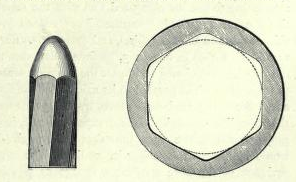
Whitworth-with-side-mounted-Davidson-scope-1Sniping was not new to the Civil War, having been used in previous conflicts, usually using a very heavy barreled target rifle and open sights or slow-loading “Kentucky rifles.” Along came a British gentleman by the name of Sir Joseph Whitworth, who experimented with rifled WhitworthBulletandRiflingartillery that used hexagon-shaped bores instead of rifled round bores. The hexagon-shaped bores were twisted like the rifling in traditional rifled arms, affecting the projectile like rifling does, giving it a stabilizing spin. He extended his ideas to small arms and developed the “Whitworth Rifle.” Not only was the bore hexagon-shaped, but the bullets were an elongated hexagon shape, matching the size and twist of the Whitworth Rifle barrels. Whitworth discovered the longer projectile needed a faster twist rate than the Minié to stabilize it. The result was a major leap forward in small arms accuracy.

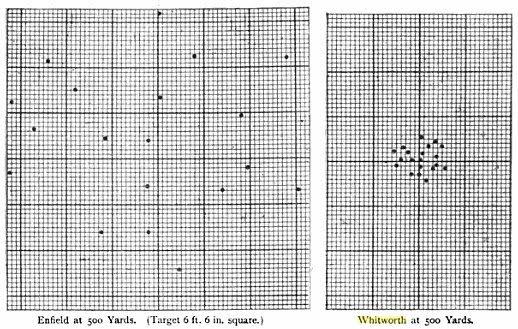
enfield-vs-whitworthTested against the Enfield Pattern of 1852 Rifle-Musket, the Whitworth could hold 9-inch groups at 500 yards (less than 2 minutes of angle), while the Enfield, which was considered very accurate in its day, could only hold 54-inch groups! For comparison, modern military small arms, like the M-16, can only hold about 2 minutes of angle (2 inches at 100 yards) unless accurized. The Whitworth could reliably hit targets out to 1,000 yards and beyond. Even though demonstrably superior in accuracy to the Enfield, the British rejected the design, because the Whitworth was four times more expensive than the Enfield to manufacture. That was not the death of the Whitworth.

Both Confederate and Union sharpshooters employed it as a sniper weapon, usually targeting artillery crews and officers at previously unheard of ranges. Most of these Whitworth Rifles used open, iron sights like those on the Springfield and Enfield, but some were equipped with 3-power telescopic sights mounted to the left side of the breech. These Whitworth Rifles were exceptionally deadly!

According to popular accounts, on May 9, 1864, during the Battle of Spotsylvania Courthouse, Union General John Sedgwick discovered just how accurate the Whitworth could be. Shots from Confederate Whitworth rifles, easily identified by the shrill whistling noises their hexagon-shaped bullets made in flight, caused members of his staff and artillerymen to duck for cover. Sedgwick chastised them and proclaimed, “I’m ashamed of you, dodging that way. They couldn’t hit an elephant at this distance.” Seconds later he pitched forward with a bullet hole below his left eye.

On Sept 19, 1863, at the Battle of Chickamauga, Union General William Lytle was leading a charge and became the target for a Confederate with a Whitworth. He was mortally wounded.

On the second day of the Battle of Gettysburg, disregarding warnings about the Federal sharpshooters armed with Whitworth rifles with telescopic sights mounted on them, Confederate General Richard Ewell and his engineer ventured to within 1,000 yards of the Union lines on Cemetery Hill. Ewell took a Whitworth round in his wooden leg, and the engineer was shot through the body and killed.

In An Eternity of Four Years, I have a scene where Ethan has an encounter with these same sharpshooters who shot at Ewell. That excerpt will be the next post.

Battlefield “technology” made huge advances just before and during the Civil War, and the resulting casualties were staggering compared to previous conflicts.

2 Comments

Filed under An Eternity of Four Years, Catahoula Books, Civil War, Firearms, History Lessons

Outhouses and Smart*** College Boys

A Tree Grows In Bartlett_03122006My friend Richard Caire and I roomed together in college. The third member of our little confederacy was Sam Hopkins, and all three of us majored in art. Richard has focused his talents on photography and Photoshop manipulation to create some truly beautiful works of art. He sent me the attached image of an outhouse near where he lives, and it reminded me of a story.

It was our second year at Southeastern Louisiana Institute (Sounds like some kind of asylum doesn’t it? Such would have been appropriate for Richard, Sam, and me.)

Anyhow, we were taking art with no real notion how we might make a living at that. Actually, we were taking art so we could drink beer, thus my claim I minored in beer. We three happy-go-lucky, beer-swilling smartasses show up for the first day of a drawing class in the fall of 1963, and after all the introduction stuff, we get our first assignment, which was to venture forth and find a nice house and draw it. The instructor’s assumption was that we would wander off campus and sketch one of the many beautiful old homes around the college.

Oh no! The Three Amigos had to turn a simple assignment into a contest of wills. We drove all over the backwoods around Hammond, Louisiana to find an outhouse to draw. They are, after all, “houses,” are they not? It might not surprise the reader to learn that finding an outhouse around Hammond in 1963 was not a major challenge.

We found a nice one, kind of leaning like the one in the picture, and approached the owners, an elderly black man and his equally elderly wife, to ask permission to sketch their outhouse. She stood off to the side and looked suspiciously at the three white boys standing there, stupid grins on our faces, sketchbooks in hand, and asking to draw their outhouse. The old man looked at us and rubbed his chin, and I am sure he was thinking, These white boys be crazy!

He was right!

But he graciously gave his permission. (We might even have given him a few bucks.)

An hour or so later, outhouse properly sketched, we departed and turned in our assignment, expecting … I’m not sure just exactly what we were expecting, now that I think about it. The instructor could have taken it badly and given us all an “F” for being so arrogant, and we would have deserved it. Instead, he evaluated them right along with all the other students sketches of “real” houses. Maybe he thought we were really creative?

So we went out for a beer to celebrate.

Image credit: © 2015 Richard A Caire

Leave a comment

Filed under College, Family History, Growing Up